
Aryans and Vedic Culture: What Evidence Do Historians Use?
Aryans and Vedic Culture: What Evidence Do Historians Use?
Historians reconstruct the early Vedic world by combining the Rigveda, comparative linguistics, archaeology and increasingly ancient DNA. These sources support movements and cultural interaction across Central and South Asia, but no single source can identify a simple racial group called the 'Aryans'.
Quick Summary
Historians reconstruct the early Vedic world by combining the Rigveda, comparative linguistics, archaeology and increasingly ancient DNA. These sources support movements and cultural interaction across Central and South Asia, but no single source can identify a simple racial group called the 'Aryans'.
☷ Table of Contents ⌃
- 1🔍 How Do We Study a Period Without Modern Historical Records?
- 2⚠️ First Understand the Word 'Aryan'
- 3📜 Evidence 1: The Rigveda
- 4📖 But the Rigveda Is Not a Modern History Book
- 5🗺️ What Geography Does the Rigveda Describe?
- 6🗣️ Evidence 2: Historical Linguistics
- 7🔤 Sanskrit and Other Indo-European Languages
- 8🇮🇷 Sanskrit and Avestan Are Especially Close
- 9🐎 Horses and Chariots in the Textual Evidence
- 10🏺 Evidence 3: Archaeology
- 11🏺 Painted Grey Ware and the Later Vedic World
- 12🧱 Is Harappan Civilization the Same as Vedic Culture?
- 13🧬 Evidence 4: Ancient DNA
- 14🧬 DNA Does Not Speak a Language
- 15🧬 Was the Population of South Asia Completely Replaced?
- 16⚔️ Migration Is Not the Same as an 'Aryan Invasion'
- 17🚶 Migration Can Happen Over Generations
- 18🤝 Interaction Matters More Than a Simple Replacement Story
- 19🗣️ Loanwords Give Another Clue
- 20🌍 What Do Historians Mean by Indo-Aryan Migration?
- 21📅 Can We Give One Exact Date?
- 22🔬 What Does Each Source Actually Tell Us?
- 23🧠 Evidence vs Overstatement
- 24⚠️ Common Exam Traps
- 25🎯 15-Second Revision
- 26📌 The Big Idea
🔍 How Do We Study a Period Without Modern Historical Records?
The beginning of the Vedic period is one of the most discussed topics in ancient Indian history. Questions often arise: Who were the Aryans? Where did Indo-Aryan languages come from? Did people migrate into the subcontinent? How are the Vedas connected with archaeology?
There is no single inscription or archaeological object that answers all these questions. Historians therefore combine several independent kinds of evidence:
- Vedic texts, especially the Rigveda,
- historical linguistics,
- archaeology,
- geography mentioned in ancient texts,
- comparisons with Iranian traditions,
- and, more recently, ancient DNA.
The important point is that a historical explanation becomes stronger when different types of evidence support one another.
⚠️ First Understand the Word 'Aryan'
In older nineteenth- and twentieth-century writing, the word Aryan was sometimes wrongly treated as the name of a biological race.
Modern historians and linguists do not use it that way.
The Sanskrit term arya occurs in Vedic literature as a social or cultural self-description in particular contexts. In modern historical discussion, terms such as Indo-Aryan are most safely used for a branch of the Indo-European language family and the cultural traditions connected with early Indo-Aryan-speaking communities.
Language, genes and ethnicity are not the same thing. A person can adopt a new language without a complete replacement of population.
📜 Evidence 1: The Rigveda
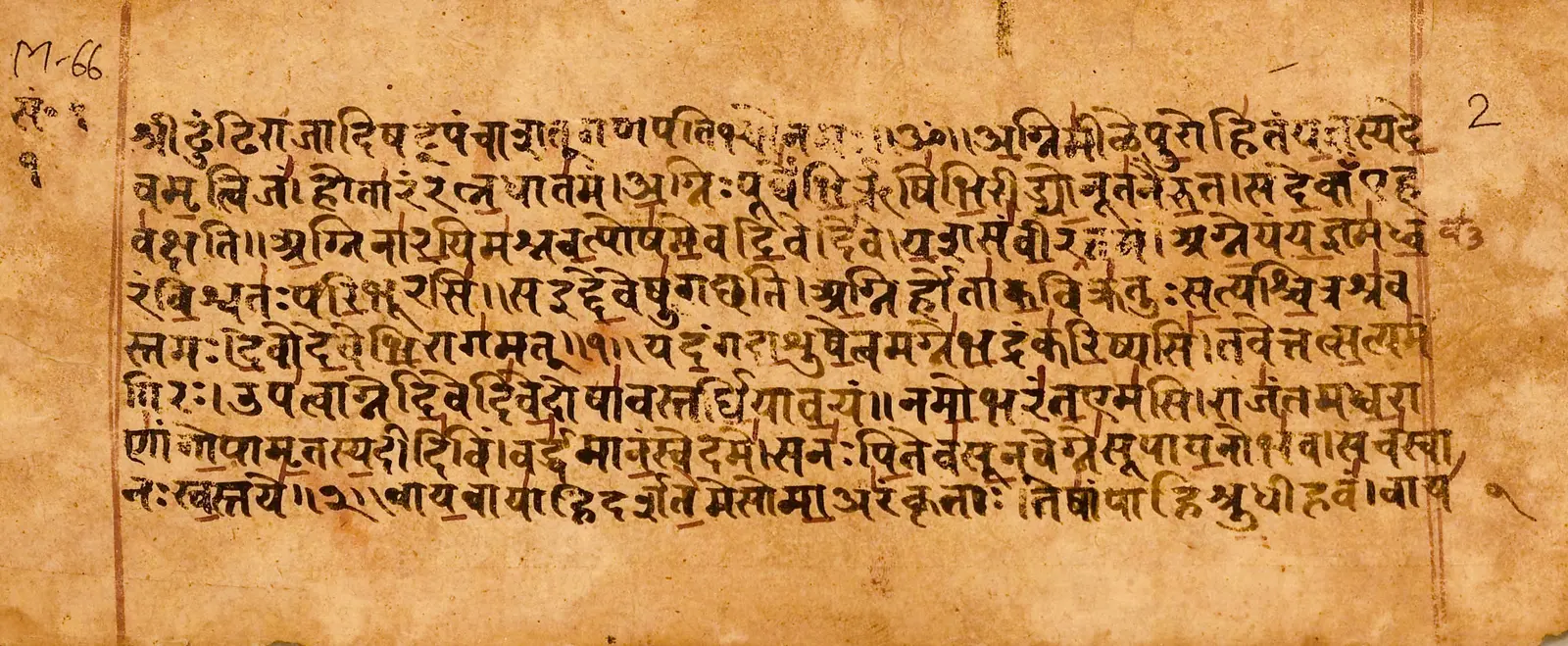
The Rigveda is the oldest of the Vedas and the most important textual source for the early Vedic world. Its hymns were composed in an early form of Vedic Sanskrit and preserved through a highly developed oral tradition long before the surviving manuscripts were written.
Historians find references in the Rigveda to:
- rivers and landscapes,
- cattle and pastoral wealth,
- horses and chariots,
- chiefs called rajan,
- groups described by terms such as jana and vis,
- conflict and alliances,
- rituals and sacrifices,
- and deities such as Indra, Agni and Varuna.
These references give historians clues about society, economy and geography.
📖 But the Rigveda Is Not a Modern History Book
This is extremely important. The Rigveda is a collection of religious and poetic hymns, not a census, political chronicle or modern textbook.
Therefore, a single verse cannot automatically be treated as a literal description of all Vedic society.
Historians ask questions such as: What was the purpose of the hymn? Is the language symbolic? Does the same idea occur in several hymns? Which layers of the text may be earlier or later?
So the Rigveda is a major historical source, but it must be interpreted rather than simply read literally.
🗺️ What Geography Does the Rigveda Describe?
Many geographical references in the Rigveda point toward the northwestern part of the Indian subcontinent.
The text mentions the Sindhu or Indus and a number of its tributaries, as well as other rivers known to Vedic tradition.
This northwestern geographical focus is one reason historians associate the earlier Rigvedic world particularly with regions of present-day Afghanistan, Pakistan and northwestern India rather than with the whole subcontinent.
Later Vedic literature shows a stronger geographical focus farther east toward the Ganga-Yamuna region.
🗣️ Evidence 2: Historical Linguistics
One of the strongest types of evidence comes from the scientific comparison of languages.
Vedic Sanskrit belongs to the Indo-European language family. It is particularly closely related to ancient Iranian languages such as Avestan.
These similarities are not limited to a few borrowed words. They occur in basic vocabulary, grammar, sounds and word forms.
This indicates that Sanskrit and ancient Iranian languages ultimately developed from earlier related languages.
🔤 Sanskrit and Other Indo-European Languages
Historical linguists noticed systematic similarities between Sanskrit and languages such as Greek, Latin and several other Indo-European languages.
For example, words expressing family relationships and basic concepts can often be traced back to shared older forms.
The important point is not that one language simply copied the other. Linguists reconstruct an older ancestral language from which different branches gradually developed.
🇮🇷 Sanskrit and Avestan Are Especially Close
For the history of the Vedic period, the relationship between Vedic Sanskrit and Avestan, the ancient language associated with Iranian religious traditions, is particularly important.
They share many words, grammatical features and religious concepts.
This suggests that Indo-Aryan and Iranian-speaking communities shared a deeper Indo-Iranian linguistic and cultural background before their traditions developed separately.
🐎 Horses and Chariots in the Textual Evidence
Horses and chariots occur prominently in the Rigveda. The horse had importance in elite imagery, warfare, racing and ritual.
Chariot terminology also has parallels across Indo-Iranian and other Indo-European linguistic traditions.
This evidence connects the early Indo-Aryan linguistic world to broader Bronze Age developments across Eurasia.
However, the presence of horse or chariot words does not by itself tell us the exact size or route of any population movement.
🏺 Evidence 3: Archaeology
Archaeology gives us settlements, pottery, metals, animal bones, tools, burials and changes in material culture.
But there is a major methodological problem: a pot does not tell us which language its owner spoke.
This is why historians avoid saying that one pottery style automatically equals one ethnic group.
Archaeology is most useful when its chronological and geographical patterns are compared carefully with other evidence.
🏺 Painted Grey Ware and the Later Vedic World
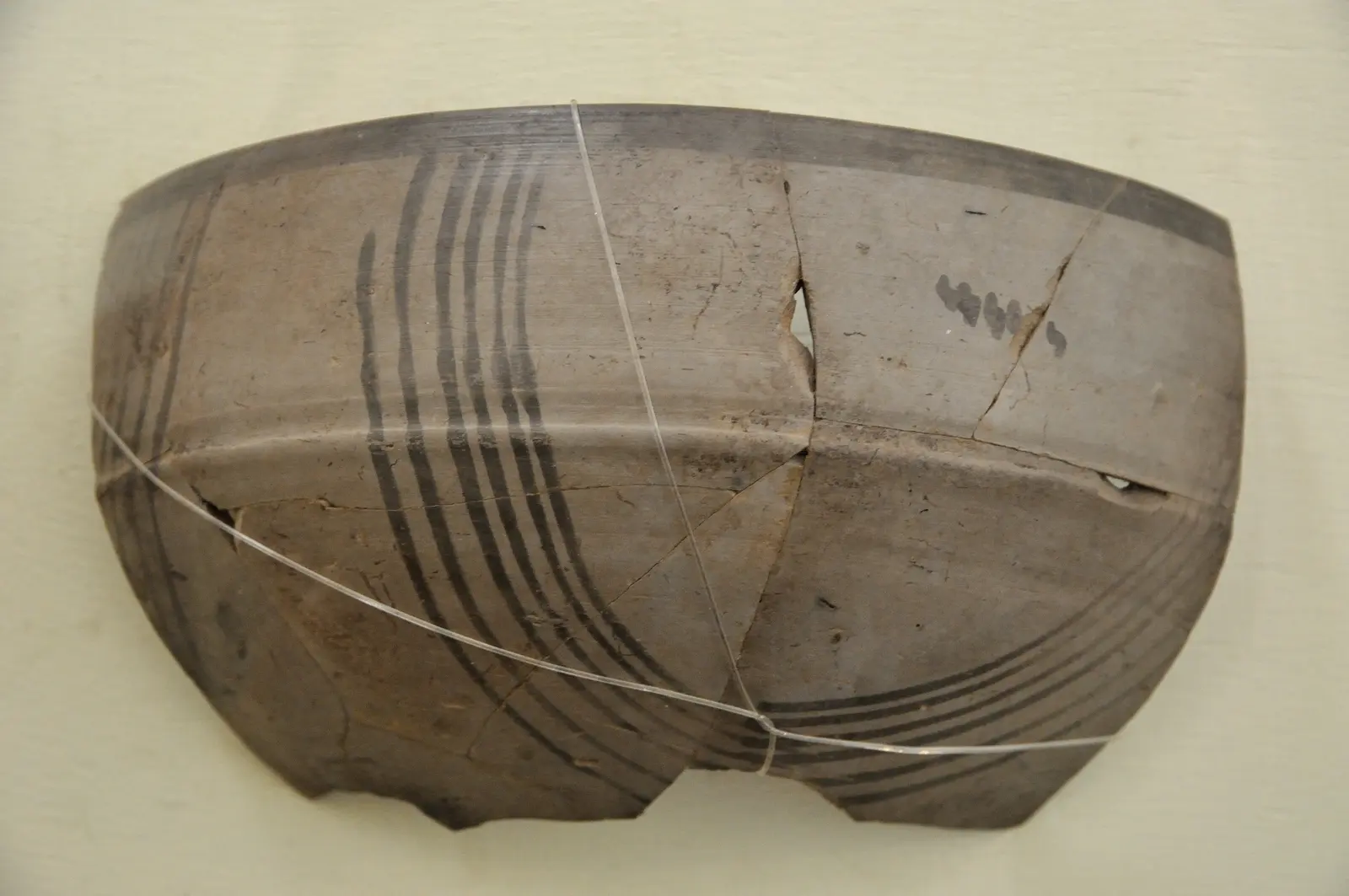
Painted Grey Ware (PGW) is a pottery tradition found mainly in parts of the upper Ganga-Yamuna region and neighbouring areas, broadly during the first millennium BCE.
Many PGW sites fall in areas that became important in later Vedic literature, especially regions associated with places such as Kuru and Panchala.
This makes PGW useful when studying the archaeology of the Later Vedic period.
But it is incorrect to say PGW pottery = Aryan people. Pottery is an archaeological culture, not a biological or linguistic label.
🧱 Is Harappan Civilization the Same as Vedic Culture?
No. The Mature Harappan urban system flourished mainly around 2600–1900 BCE, while the main composition of the Rigvedic hymns is generally placed later in the second millennium BCE.
There are major differences in the archaeological and textual worlds: Harappan civilization was strongly urban, while the early Rigvedic hymns reflect a society in which cattle, mobile pastoral life and smaller political communities were especially prominent.
But history is not a story of two completely sealed populations either. After the urban decline, people of the post-Harappan world continued living across South Asia, and later populations formed through interaction and mixture.
🧬 Evidence 4: Ancient DNA
Ancient DNA has added an important new type of evidence to this debate.
Large genetic studies of ancient individuals from Central and South Asia show that ancestry related to Middle to Late Bronze Age Steppe pastoralist populations entered South Asia during the second millennium BCE.
This ancestry is present in later South Asian populations and is consistent with other evidence connecting Indo-Aryan languages with wider Indo-European and Indo-Iranian movements across Eurasia.
But this finding needs careful interpretation.
🧬 DNA Does Not Speak a Language
A genome cannot tell us directly whether a person spoke Vedic Sanskrit, called themselves arya or followed a particular ritual.
Genetic data can show biological ancestry and population mixture. Linguistics studies languages. Archaeology studies material remains. Texts provide cultural and conceptual evidence.
Therefore the strongest historical reconstruction comes from combining these fields, not replacing one with another.
🧬 Was the Population of South Asia Completely Replaced?
No.
Genetic research shows extensive mixture, not a simple picture in which one population arrived and completely replaced everyone living in South Asia.
South Asian populations were formed from several ancient ancestry streams over long periods. Steppe-related ancestry was one later component added to already complex populations.
This is one reason the old image of a single 'Aryan race' replacing another population is historically misleading.
⚔️ Migration Is Not the Same as an 'Aryan Invasion'
Older textbooks sometimes presented a dramatic story in which armed Aryan invaders suddenly entered India and destroyed the Indus Civilization.
Modern archaeology does not support this simple invasion-and-destruction model.
The Mature Harappan urban system was already undergoing a long transformation involving environmental and economic changes. There is no archaeological evidence of one massive military invasion that destroyed all Harappan cities at the same time.
Population movement into South Asia and violent conquest of the entire Harappan civilization are therefore two different claims. Evidence for migration does not automatically prove the old invasion story.
🚶 Migration Can Happen Over Generations
The word migration does not necessarily mean a single army crossing a border on one date.
People can move gradually through:
- pastoral mobility,
- marriage networks,
- small-group migration,
- trade and seasonal movement,
- and repeated movements over many generations.
Languages and cultural practices can spread through such long processes.
🤝 Interaction Matters More Than a Simple Replacement Story
The early Vedic world developed in a subcontinent already populated by many communities with long local histories.
Incoming groups would have interacted with existing populations. Languages could borrow words, people could intermarry, rituals could change and local practices could be absorbed into new traditions.
Therefore Vedic culture should not be imagined as arriving fully formed in one moment. It developed over time through movement, interaction and cultural change.
🗣️ Loanwords Give Another Clue
Vedic Sanskrit contains some words that are difficult to explain from inherited Indo-European vocabulary and may have been borrowed from other languages spoken in South Asia.
Such loanwords are evidence of contact between Indo-Aryan speakers and communities speaking other languages.
This again points toward interaction rather than complete cultural isolation.
🌍 What Do Historians Mean by Indo-Aryan Migration?
In modern academic usage, Indo-Aryan migration generally refers to movements of Indo-Aryan-speaking populations and cultural traditions into the northwestern subcontinent during the second millennium BCE as part of broader Indo-Iranian and Eurasian developments.
This model is based mainly on the combined evidence of linguistics, archaeology and archaeogenetics.
It should not be confused with nineteenth-century racial theories.
📅 Can We Give One Exact Date?
No.
Historical dates such as c. 1500 BCE are useful broad chronological markers, not a date on which one identifiable people suddenly crossed into India.
Text composition, population movement and cultural change occurred across generations.
That is why historians use circa or approximate ranges.
🔬 What Does Each Source Actually Tell Us?
Rigveda → language, rituals, deities, rivers, cattle, political and social terms.
Linguistics → relationship of Vedic Sanskrit with Iranian and wider Indo-European languages.
Archaeology → settlements, pottery, technology, animals and material change.
Ancient DNA → biological ancestry, population movement and mixture.
None of these alone → a complete history of one clearly bounded ethnic group.
🧠 Evidence vs Overstatement
Evidence: Sanskrit is Indo-European and closely related to Avestan.
Reasonable conclusion: Indo-Aryan and Iranian languages share earlier ancestry.
Evidence: Steppe-related ancestry entered South Asia in the second millennium BCE.
Reasonable conclusion: population movement occurred.
Wrong leap: every person with that ancestry was a Vedic priest or belonged to one pure 'Aryan race'.
Evidence: PGW occurs in later Vedic geographical areas.
Wrong leap: every PGW pot was made by an 'Aryan'.
⚠️ Common Exam Traps
- Aryan should not be treated as a scientifically defined biological race.
- Indo-Aryan is primarily a linguistic term in modern scholarship.
- The Rigveda is the major textual source for the early Vedic period.
- Vedic Sanskrit is closely related to Avestan.
- Early Rigvedic geography is strongly associated with the northwestern subcontinent.
- Painted Grey Ware is useful for studying later Vedic archaeology, but pottery cannot automatically identify ethnicity or language.
- Ancient DNA supports population movement and mixture involving Steppe-related ancestry in the second millennium BCE.
- Migration evidence is not the same thing as proof of the old Aryan invasion theory.
🎯 15-Second Revision
Text → Rigveda.
Language → Sanskrit + Avestan → Indo-Iranian relationship.
Archaeology → settlements + pottery + material culture.
DNA → Steppe-related ancestry enters and mixes with South Asian populations.
Conclusion → migration and interaction, not a simple racial invasion story.
📌 The Big Idea
The history of the early Vedic world cannot be reconstructed from one source. The Rigveda gives us the voices and ideas of Vedic tradition; linguistics connects Vedic Sanskrit to the wider Indo-European family; archaeology provides the material background; and ancient DNA reveals population movement and mixture.
When these sources are read together, the picture that emerges is not of a pure race suddenly replacing another civilization. It is a much more complex history of movement, interaction, mixture and the gradual formation of Vedic culture in South Asia.
Was this article helpful?
Help us improve by giving your feedback.
Test your understanding
Which is the most important textual source for reconstructing the early Vedic world?
- A. Arthashastra
- B. Rigveda
- C. Akbarnama
- D. Rajatarangini
The Rigveda is the oldest Vedic collection and the most important textual source for studying early Vedic society.
Vedic Sanskrit is especially closely related to which ancient language?
- A. Classical Chinese
- B. Mayan
- C. Avestan
- D. Japanese
Vedic Sanskrit and Avestan share many systematic linguistic features and belong to the Indo-Iranian branch of Indo-European.
The geographical focus of the earliest Rigvedic hymns is most strongly associated with which region?
- A. The northwestern subcontinent
- B. Deep southern Tamil Nadu
- C. Eastern coastal Bengal only
- D. Sri Lanka only
River names and other geographical references place much of the early Rigvedic world in the northwestern subcontinent.
Why should 'Aryan' not be treated as the name of a scientifically defined biological race?
- A. Because the word was invented in the twentieth century
- B. Because Sanskrit has no such related terms
- C. Because no human populations existed at the time
- D. Modern scholarship distinguishes linguistic and cultural identity from biological ancestry
Indo-Aryan is primarily a linguistic-historical term; language, cultural identity and genetic ancestry cannot simply be treated as identical.
What is the safest way to use Painted Grey Ware in Vedic history?
- A. Treat every PGW vessel as proof of one Aryan ethnic group
- B. Use it as archaeological evidence for regions important in the Later Vedic period without equating pottery directly with ethnicity
- C. Assume it was produced only by Harappan city rulers
- D. Ignore its archaeological context
PGW is useful for studying later Vedic archaeological landscapes, but a pottery tradition cannot by itself identify the language or ethnicity of its makers.
What has ancient DNA research added to the study of early Indo-Aryan history?
- A. It has identified the name of every Vedic chief
- B. It has translated the Rigveda
- C. It provides evidence of Steppe-related ancestry entering and mixing in South Asia during the second millennium BCE
- D. It proves that every South Asian has identical ancestry
Ancient DNA studies show movements of Steppe-related ancestry into South Asia and subsequent population mixture during the second millennium BCE.
Why does evidence for Indo-Aryan migration not automatically prove the old 'Aryan invasion' theory?
- A. Migration can occur gradually through repeated population movement and interaction, while archaeology does not show one simultaneous military destruction of all Harappan cities
- B. Because migration and invasion always mean exactly the same thing
- C. Because the Harappan Civilization existed after the Mauryan Empire
- D. Because ancient DNA cannot detect any population movement
Evidence supports movement and mixture, but the old model of a single invading army suddenly destroying the entire Harappan civilization is not supported by archaeology.
Which approach gives historians the strongest reconstruction of early Vedic origins?
- A. Using only genetics
- B. Using only one Rigvedic verse
- C. Equating one pottery style with one race
- D. Comparing textual, linguistic, archaeological and genetic evidence while respecting the limits of each
No single source can reconstruct the entire process. The strongest historical explanation combines independent forms of evidence without treating them as interchangeable.