
Political and Social Organization of the Indus Civilization: What Do We Know?
Political and Social Organization of the Indus Civilization: What Do We Know?
The Indus Civilization had large planned cities, standardized weights and bricks, wide trade networks and organized public works. Yet no confirmed king, royal dynasty, palace or political text is known. Archaeology therefore shows strong organization but does not reveal exactly who ruled Harappan society.
Quick Summary
The Indus Civilization had large planned cities, standardized weights and bricks, wide trade networks and organized public works. Yet no confirmed king, royal dynasty, palace or political text is known. Archaeology therefore shows strong organization but does not reveal exactly who ruled Harappan society.
☷ Table of Contents ⌃
- 1🏛️ Who Ruled the Harappan Civilization?
- 2🧩 Organization Is Clear, Government Is Not
- 3🏙️ Planned Cities Required Coordination
- 4🧱 Standardized Bricks Across a Huge Region
- 5⚖️ Standardized Weights Tell a Similar Story
- 6👑 Where Are the Kings?
- 7🧔 The Famous 'Priest-King'
- 8🏰 Where Are the Palaces?
- 9⚱️ No Egyptian-Style Royal Tombs
- 10💰 Was Everyone Equal?
- 11🏠 House Size Gives Us a Clue
- 12💎 Luxury Goods and Social Differences
- 13⚒️ Craftspeople and Occupational Specialization
- 14🌾 Farmers Were the Foundation
- 15🚚 Traders Connected Distant Regions
- 16🏢 Was There a Central Government?
- 17🗺️ One Empire or Many Connected Regions?
- 18📦 Did Rulers Collect Taxes?
- 19🛠️ Who Maintained the Drains?
- 20🪖 What About Armies and Warfare?
- 21👥 What Might Harappan Society Have Looked Like?
- 22🔍 Why Is the Indus Script So Important Here?
- 23🧠 Evidence vs Interpretation
- 24⚠️ Common Exam Traps
- 25🎯 10-Second Revision
- 26📌 The Big Idea
🏛️ Who Ruled the Harappan Civilization?
This sounds like a simple question, but it is one of the hardest questions about the Indus or Harappan Civilization.
We know that the Harappans built large cities, maintained drainage systems, used standardized bricks and weights, produced specialized crafts and participated in long-distance trade.
All this required considerable organization.
But there is a major problem: we do not know who exercised political power.
No Harappan inscription has yet been read securely. No confirmed list of kings survives. No building can be identified with certainty as a royal palace, and no royal tomb comparable to those of Egypt has been found.
🧩 Organization Is Clear, Government Is Not
Archaeology gives us strong evidence that Harappan society was organized. What it does not give us is a clear description of its government.
This distinction is important:
Evidence: standardized bricks, planned streets, drains and weights.
Inference: some institutions or groups must have helped maintain shared rules.
Unknown: whether those institutions were controlled by kings, councils, merchants, priests, local elites or some combination of them.
🏙️ Planned Cities Required Coordination
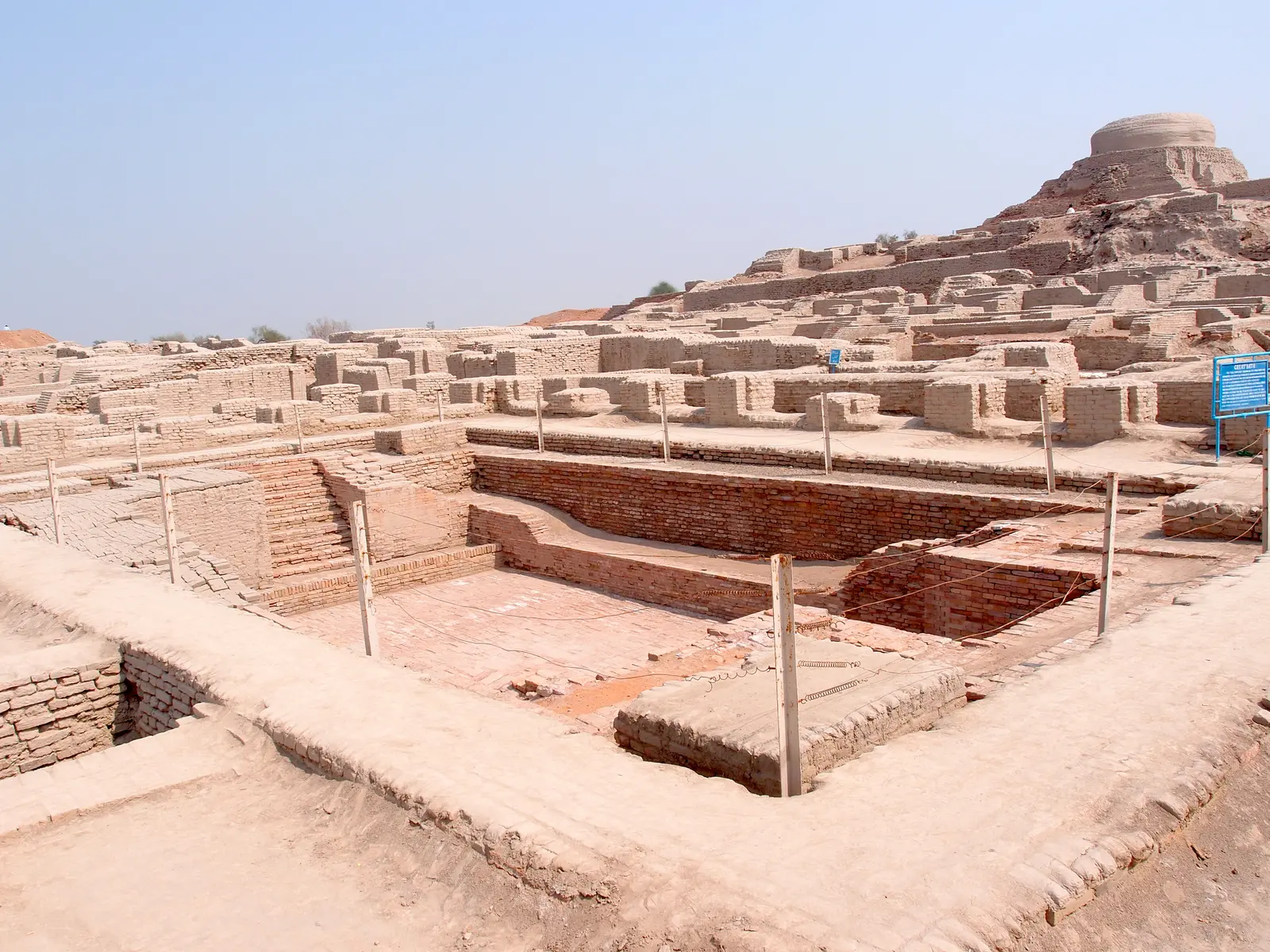
Cities such as Harappa and Mohenjo-daro were not random collections of houses. Streets followed planned layouts, drainage systems connected many buildings, bricks were made in standardized proportions and important structures were carefully constructed.
Such urban planning suggests that decisions were coordinated beyond the level of a single household.
Someone had to organize construction, maintain shared spaces and ensure that certain building practices were followed.
But archaeology cannot yet tell us whether that 'someone' was a king, a council, a group of powerful families or another institution.
🧱 Standardized Bricks Across a Huge Region
One of the most remarkable Harappan features is the widespread use of bricks with similar proportions. A common proportion was approximately 1:2:4 for thickness, width and length.
Similar standards appear at settlements separated by great distances.
This tells us that shared ideas and conventions spread across the Harappan world.
However, standardization does not automatically prove that one emperor issued orders to every settlement. Common standards can also spread through shared traditions, institutions, training and economic networks.
⚖️ Standardized Weights Tell a Similar Story
Harappan stone weights also followed carefully regulated patterns. This would have been useful in trade and the exchange of valuable materials.
If traders in different cities recognized similar weight standards, transactions became easier and more reliable.
Again, this shows coordination and shared conventions, but it does not by itself reveal the exact political structure.
👑 Where Are the Kings?
In ancient Egypt, rulers built pyramids and left inscriptions naming pharaohs. Mesopotamian rulers recorded wars, laws and building projects.
The Harappan archaeological record looks very different.
We do not have:
- a securely identified Harappan king,
- a readable royal inscription,
- a confirmed royal dynasty,
- a monumental royal tomb,
- or a building securely identified as a palace.
This does not prove that kings did not exist. It simply means that archaeology has not yet demonstrated Harappan kingship clearly.
🧔 The Famous 'Priest-King'
A small stone sculpture from Mohenjo-daro shows a bearded man wearing a decorated garment. It became famous under the name 'Priest-King'.
The name sounds impressive, but it can be misleading.
No readable inscription identifies this person. We do not know his name, profession or political position. We cannot even prove that he was a priest or a king.
'Priest-King' is a modern archaeological nickname, not a known Harappan title.
🏰 Where Are the Palaces?
Harappan cities contained large and impressive buildings, but none has been universally accepted as a royal palace.
This is important because archaeologists cannot simply assume that every large building belonged to a ruler.
A large structure could have served administrative, storage, ceremonial, communal or other purposes.
Without readable inscriptions, identifying the owner or exact function remains difficult.
⚱️ No Egyptian-Style Royal Tombs
Harappan cemeteries contain burials with pottery, ornaments and other objects, but the civilization has not produced enormous royal tombs comparable to Egyptian pyramids or some Mesopotamian elite burials.
This may indicate that Harappan elites expressed power differently. It may also mean that some forms of elite burial have not survived or have not yet been discovered.
What we should not do is turn absence of evidence into absolute proof that there were no powerful elites.
💰 Was Everyone Equal?
No. The absence of giant royal monuments does not mean Harappan society was completely equal.
Differences can be seen in house sizes, access to valuable materials, ornaments and the distribution of certain luxury objects.
Some houses were much larger than others. Rare materials and finely made ornaments were not distributed equally.
These differences suggest some form of social and economic inequality.
🏠 House Size Gives Us a Clue
Harappan cities contained houses of different sizes. Some were relatively modest, while others had many rooms and larger courtyards.
A larger house does not automatically prove that its owner was a political ruler, but differences in domestic space can reflect differences in wealth, household size or social position.
Archaeologists therefore use houses as one clue when reconstructing social hierarchy.
💎 Luxury Goods and Social Differences
Objects made from rare or costly materials can also reveal social differences.
Gold ornaments, finely worked stones, elaborate beads and other valuable items required resources and skilled labour.
If such objects were concentrated among particular households or burials, they may indicate differences in access to wealth.
However, wealth and political authority are not necessarily the same thing. A rich merchant does not automatically have to be a king.
⚒️ Craftspeople and Occupational Specialization
Harappan society included skilled craftspeople who made beads, pottery, metal objects, shell products, seals and other goods.
Some settlements, such as Chanhudaro, show strong evidence of specialized craft production.
This suggests a society in which different people performed different economic roles: farmers, herders, craftspeople, traders, builders and possibly administrators.
Such specialization usually depends on networks through which food, raw materials and finished goods can be exchanged.
🌾 Farmers Were the Foundation
Even the largest Harappan city depended on agriculture.
Farmers and herders produced the food that supported urban populations. Cities therefore depended on their surrounding countryside and on networks linking rural producers with urban consumers.
The relationship between village and city was a central part of Harappan society.
🚚 Traders Connected Distant Regions
Harappan traders and exchange networks moved materials across large distances. Carnelian, shell, metals and other raw materials often had to travel from their natural sources to craft centres and cities.
Harappan-style objects also reached the Persian Gulf and Mesopotamia.
People who managed trade and valuable goods may have held important social positions, but we cannot identify a clearly defined 'merchant class' from readable Harappan texts because those texts remain unavailable.
🏢 Was There a Central Government?
This remains debated.
One possibility is that the civilization had some form of centralized authority capable of maintaining common standards across a huge region.
Another possibility is that different cities or regions were governed locally while sharing cultural and economic conventions.
A third possibility is that authority was distributed among several institutions or elite groups rather than concentrated in a single monarch.
At present, archaeology cannot conclusively choose one model.
🗺️ One Empire or Many Connected Regions?
The Harappan Civilization covered an enormous area, with major cities and hundreds of smaller settlements spread across different environments.
Despite shared features, regional differences also existed in pottery, settlement patterns, raw materials and local traditions.
Therefore, describing the entire civilization as a single empire ruled from one capital goes beyond the available evidence.
A safer description is that it was a large, highly connected cultural and economic system with strong shared conventions and regional variation.
📦 Did Rulers Collect Taxes?
It is possible that some authority collected food, labour or goods to support public works, specialists and urban institutions.
But we have no readable Harappan tax records telling us how such a system worked.
Large construction projects required labour and resources, yet the exact mechanism used to mobilize them remains unknown.
🛠️ Who Maintained the Drains?
This simple question reveals the larger political mystery.
Harappan cities had sophisticated drainage systems. Drains needed to be constructed, connected and sometimes cleaned or repaired.
A shared urban system suggests some level of collective management or authority.
But the drains do not tell us the name or title of the people who organized that work.
🪖 What About Armies and Warfare?
Weapons such as spearheads, arrowheads and blades are known, but Harappan art does not emphasize warfare and military kingship in the same way as some contemporary civilizations.
There are no securely identified monumental victory scenes showing Harappan kings crushing enemies.
This does not mean warfare never occurred. It means that military power is not displayed clearly in the surviving Harappan archaeological record.
👥 What Might Harappan Society Have Looked Like?
Based on archaeological evidence, Harappan society probably included people performing many different roles:
- farmers and herders,
- craft specialists,
- traders and transporters,
- builders and labourers,
- people with greater access to wealth or prestigious goods,
- and probably people responsible for administration or collective decisions.
But we cannot turn these broad groups into a rigid caste or class system without evidence.
🔍 Why Is the Indus Script So Important Here?
If the Indus script were securely deciphered, it might tell us whether seals contain personal names, official titles, institutions, places or administrative information.
That could completely change our understanding of Harappan politics.
Until then, political organization has to be reconstructed mainly from buildings, settlement patterns, craft production, trade, weights, seals and differences in material wealth.
🧠 Evidence vs Interpretation
Evidence: standardized bricks.
Interpretation: shared construction rules or institutions.
Evidence: planned streets and drains.
Interpretation: coordinated urban management.
Evidence: houses of different sizes and unequal access to luxury goods.
Interpretation: some degree of social inequality.
Evidence: no confirmed palace or royal tomb.
Wrong conclusion: therefore Harappan society definitely had no rulers.
⚠️ Common Exam Traps
- No Harappan ruler has been securely identified by name.
- The famous 'Priest-King' is not proven to have been a priest or king.
- No building has been securely identified as a Harappan royal palace.
- No Egyptian-style monumental royal tomb is known.
- Standardized bricks and weights show coordination, but do not by themselves prove a single centralized empire.
- Differences in houses and valuable goods suggest social inequality.
- The exact Harappan political system remains uncertain.
🎯 10-Second Revision
Political system: uncertain.
King: no securely identified ruler.
Priest-King: modern nickname.
Organization: strong evidence from cities, drains, bricks and weights.
Society: specialized occupations + some inequality.
Single empire: not proven.
📌 The Big Idea
The biggest puzzle of Harappan politics is almost a contradiction: the civilization looks highly organized, but the people who organized it are nearly invisible to us.
Its planned cities, drainage systems, standardized bricks, weights and trade networks show coordination on a remarkable scale. Yet there are no securely identified kings, dynasties or royal inscriptions.
So the best historical answer is not 'Harappans had no rulers' or 'one emperor ruled everything'. The correct answer is: Harappan society clearly had systems of organization and social differences, but the exact form of political authority remains unknown.
Was this article helpful?
Help us improve by giving your feedback.
Test your understanding
What do planned Harappan cities most clearly indicate?
- A. Every city was ruled by the same known emperor
- B. A significant level of organization and coordination existed
- C. Harappans had no administration
- D. All houses were identical
Planned streets, drains and standardized construction indicate considerable coordination, although the exact political authority remains unknown.
Why is the term 'Priest-King' potentially misleading?
- A. The sculpture is from Egypt
- B. The figure is actually a woman
- C. There is no evidence proving that the figure was a priest or king
- D. The sculpture has never been found
Priest-King is a modern nickname. No readable inscription identifies the figure's actual role.
Which evidence suggests social differences within Harappan society?
- A. Differences in house sizes and access to valuable goods
- B. Every person had an identical house
- C. All burials contained the same wealth
- D. Written caste lists
Differences in houses and the distribution of valuable materials suggest some degree of social and economic inequality.
What does the standardization of Harappan bricks prove most safely?
- A. One identified emperor personally designed every city
- B. Every Harappan house belonged to the state
- C. There were no regional differences
- D. Shared construction conventions existed across a wide region
Standardized brick proportions show widespread shared construction practices, but do not by themselves prove one centralized empire.
Which statement about Harappan kingship is most accurate?
- A. A complete list of Harappan kings is known
- B. No Harappan ruler has been securely identified from readable evidence
- C. The Priest-King definitely ruled Mohenjo-daro
- D. Harappan royal inscriptions describe many wars
No securely deciphered royal inscription or confirmed list of Harappan rulers is known.
Which group formed the basic food-producing foundation of Harappan urban life?
- A. Only priests
- B. Only foreign traders
- C. Farmers and herders
- D. Only seal makers
Urban populations depended on agricultural and pastoral production from rural areas for their food supply.
Which conclusion best fits the current evidence about Harappan political organization?
- A. The civilization was highly organized, but the exact form of political authority remains uncertain
- B. It has been proven that one emperor ruled every settlement
- C. Harappan society had no political organization
- D. Every city was certainly an independent democracy
Urban planning and standardization demonstrate organization, but the evidence does not securely establish one specific form of government.
Why would decipherment of the Indus script be especially important for understanding Harappan politics?
- A. It would reveal the exact colour of every Harappan house
- B. It would prove that every seal belonged to a king
- C. It would eliminate the need for archaeology
- D. It might reveal names, titles, institutions or administrative information
Readable inscriptions could provide direct evidence about individuals, offices and institutions that archaeology alone cannot securely identify.