
Transformation and Decline of the Indus Civilization: Major Theories
Transformation and Decline of the Indus Civilization: Major Theories
After about 1900 BCE, the Mature Harappan urban system changed significantly. Large cities declined, long-distance networks weakened and settlement patterns shifted, but the civilization did not disappear suddenly. Archaeology increasingly points to a long transformation involving climate stress, changing rivers, local floods, economic disruption and migration.
Quick Summary
After about 1900 BCE, the Mature Harappan urban system changed significantly. Large cities declined, long-distance networks weakened and settlement patterns shifted, but the civilization did not disappear suddenly. Archaeology increasingly points to a long transformation involving climate stress, changing rivers, local floods, economic disruption and migration.
☷ Table of Contents ⌃
- 1🌅 Did the Indus Civilization Suddenly Disappear?
- 2🧠 The Most Important Idea: Decline of Cities Is Not Disappearance of People
- 3🏙️ What Changed After About 1900 BCE?
- 4🌦️ Theory 1: Weakening Monsoon and Long Droughts
- 5🌾 How Could Drought Affect a City?
- 6🌊 Theory 2: Rivers Changed Their Behaviour
- 7🗺️ Movement Toward the East and South
- 8🌊 Theory 3: Flooding in Some Regions
- 9🌳 Theory 4: Environmental Pressure and Resource Use
- 10🚢 Theory 5: Weakening Long-Distance Trade
- 11⚒️ What Happened to Specialized Crafts?
- 12⚖️ Standardization Began to Weaken
- 13👑 Did Political Authority Break Down?
- 14⚔️ The Old Aryan Invasion Theory
- 15💀 What About the 'Massacre' at Mohenjo-daro?
- 16🦠 Disease?
- 17🌾 People Adapted Their Farming
- 18🏡 From Big Cities to Smaller Settlements
- 19🔄 What Continued After the Urban Decline?
- 20🧠 One Cause or Many Causes?
- 21📅 Was 1900 BCE the Exact Day the Civilization Ended?
- 22🧭 Collapse or Transformation?
- 23⚠️ Common Exam Traps
- 24🎯 10-Second Revision
- 25📌 The Big Idea
🌅 Did the Indus Civilization Suddenly Disappear?
No. The decline of the Indus or Harappan Civilization is better understood as a long process of transformation rather than one sudden collapse.
The major urban phase, known as the Mature Harappan period, flourished broadly between about 2600 and 1900 BCE. After about 1900 BCE, several large cities lost their earlier importance, some settlements were abandoned, long-distance trade weakened and many people moved into smaller settlements.
But Harappan people did not simply vanish. Many technologies, pottery traditions, farming practices and local cultural elements continued into later regional cultures.
🧠 The Most Important Idea: Decline of Cities Is Not Disappearance of People
This distinction is essential.
What declined? The large integrated urban system of the Mature Harappan phase.
What did not necessarily disappear? The people, villages, farming traditions, crafts and many cultural practices.
So instead of imagining an entire civilization suddenly ending one day, it is more accurate to picture large cities shrinking, populations moving and society becoming more regional and less urban.
🏙️ What Changed After About 1900 BCE?
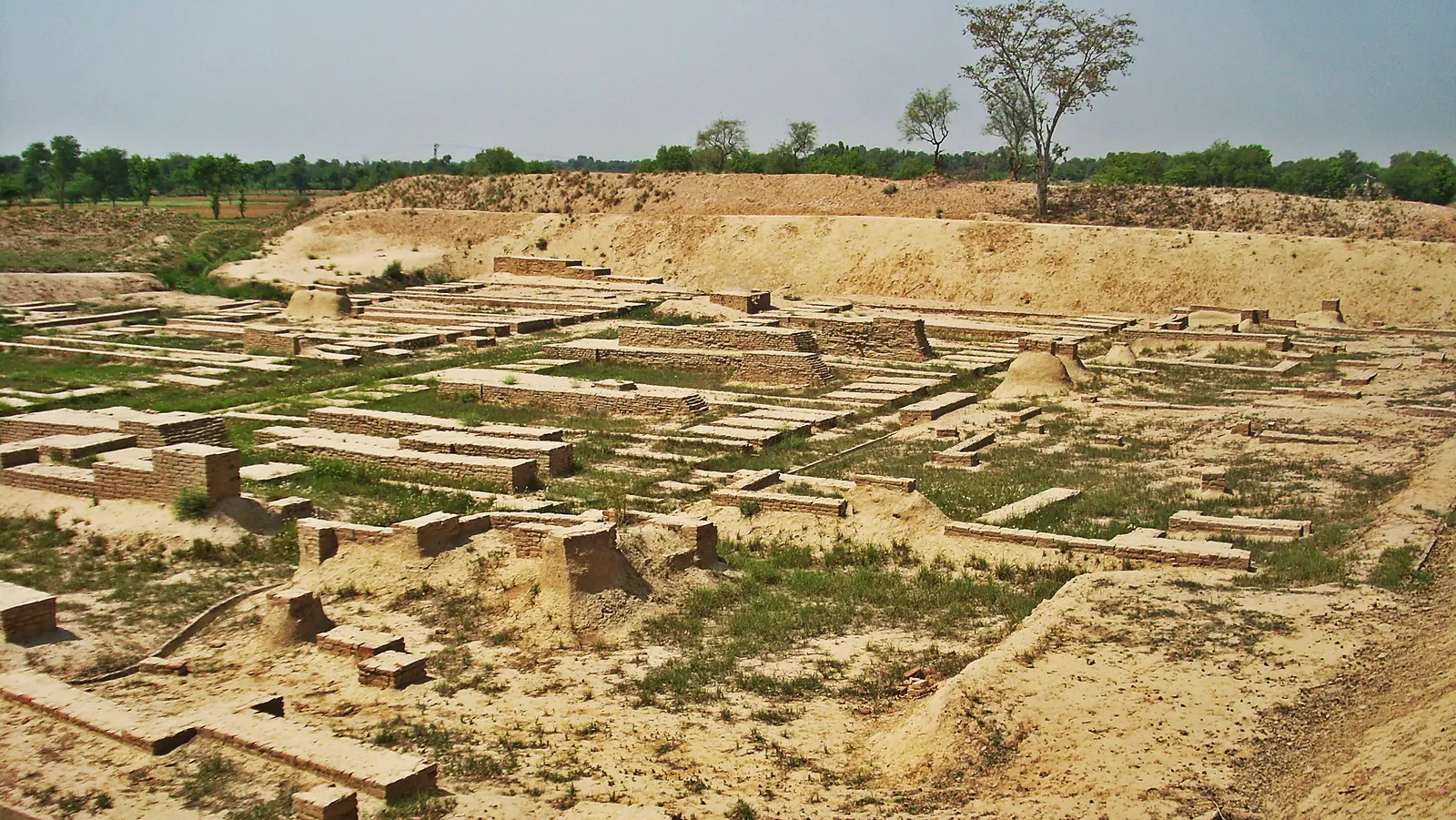
Archaeologists see several important changes after about 1900 BCE:
- many large urban centres declined in size or importance,
- some settlements in Sindh and western Punjab were abandoned,
- smaller settlements became more common,
- settlement activity shifted toward eastern and southern regions,
- long-distance trade networks became less prominent,
- standardization in weights, seals and some craft traditions weakened,
- regional pottery and cultural styles became more visible.
These changes are often called de-urbanization — a movement away from large, highly integrated city life toward smaller and more regional communities.
🌦️ Theory 1: Weakening Monsoon and Long Droughts
Climate change is one of the strongest factors discussed in modern research.
Paleoclimate studies indicate that rainfall patterns became less reliable and monsoon strength weakened during the period when Harappan urbanism was under stress.
Recent research has identified long episodes of drought during the later Mature and Late Harappan periods. Reduced rainfall would have affected river flow, crop production and the ability of large cities to support dense populations.
A city with thousands of residents requires a dependable food surplus. If rainfall becomes weaker or unpredictable for generations, agriculture becomes more difficult and the entire urban economy can come under pressure.
🌾 How Could Drought Affect a City?
The chain may have looked something like this:
less reliable rainfall → lower river flow or soil moisture → pressure on crops → smaller agricultural surplus → difficulty supporting large cities and specialists.
This does not mean one drought destroyed every city. Climate stress acted differently in different regions and over a long period.
🌊 Theory 2: Rivers Changed Their Behaviour
Harappan life depended heavily on rivers and seasonal water systems. If a river changed course, weakened or became seasonal, settlements depending on it could face serious problems.
Geological studies show that river landscapes across the Harappan region changed over time. In some areas, reduced monsoon rainfall made smaller monsoon-fed rivers less dependable.
Settlements located beside such rivers may have been abandoned or reduced as water became harder to obtain.
This helps explain why population patterns changed rather than every settlement ending at the same time.
🗺️ Movement Toward the East and South
As environmental conditions changed, many settlements became more common in areas toward Haryana, western Uttar Pradesh and Gujarat/Saurashtra.
This is a very important point: population movement suggests adaptation, not simply destruction.
People could move toward areas where rainfall, groundwater or farming conditions were more dependable.
🌊 Theory 3: Flooding in Some Regions
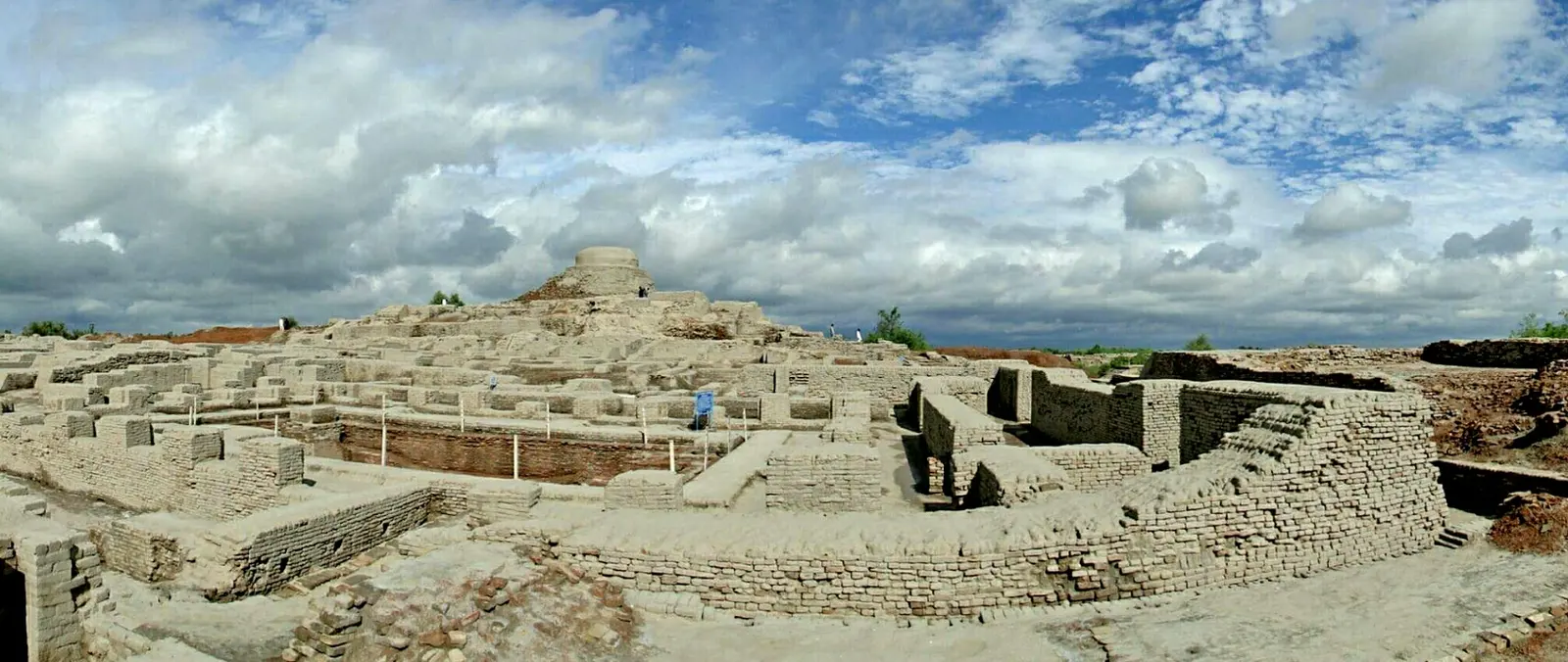
Flooding also affected parts of the Indus region, especially settlements such as Mohenjo-daro.
Archaeological layers at Mohenjo-daro show episodes of rebuilding and flood-related damage. Changes in the Indus river system could have made urban life more difficult at particular times.
But flooding cannot explain the decline of the entire civilization. A flood in Sindh cannot by itself explain changes occurring hundreds of kilometres away in Haryana, Rajasthan or Gujarat.
Therefore, floods are best understood as a local or regional factor, not a single universal cause.
🌳 Theory 4: Environmental Pressure and Resource Use
Older explanations also suggested that deforestation and heavy use of natural resources may have created environmental pressure.
Wood was required for fuel, brick-making and metalworking, while large herds of animals required grazing land.
Overuse of vegetation could have affected local environments in some places.
However, evidence is not strong enough to treat deforestation as the single explanation for the decline of the entire Harappan world.
🚢 Theory 5: Weakening Long-Distance Trade
The Mature Harappan economy was linked by large internal exchange networks and contacts with the Persian Gulf and Mesopotamia.
After about 2000 BCE, wider Bronze Age trade systems in western Asia also changed. If overseas and interregional exchange weakened, Harappan craft centres that depended on imported raw materials and distant markets may have been affected.
This could reduce demand for specialized goods such as elaborate beads, seals and other products.
Trade decline probably did not cause the entire transformation by itself, but it could have made existing environmental and economic problems worse.
⚒️ What Happened to Specialized Crafts?
Large cities support specialists because farmers can produce enough surplus food to feed people who do not grow their own crops.
If cities shrink and trade networks weaken, highly specialized production becomes harder to maintain at the same scale.
Archaeologists observe changes in standardized seals, weights, pottery and craft styles during the Late Harappan period.
This reflects a more regional economy rather than the highly connected system of the Mature Harappan phase.
⚖️ Standardization Began to Weaken
During the Mature Harappan period, similar weights, seals, brick proportions and craft styles appeared across a vast region.
Later, this uniformity became weaker. Regional forms became more common.
This suggests that the institutions or networks that once connected distant settlements were no longer operating in exactly the same way.
Again, this is evidence for decentralization and regionalization.
👑 Did Political Authority Break Down?
Some historians have suggested that the institutions responsible for maintaining cities and shared standards may have lost authority.
This is possible, especially because large public works and standardized systems require coordination.
But because we do not know the exact Harappan political system in the first place, it is difficult to say precisely what kind of government 'collapsed'.
The cautious conclusion is that the systems that coordinated the Mature Harappan urban world became weaker or changed.
⚔️ The Old Aryan Invasion Theory
Older histories sometimes claimed that invading Aryans destroyed the Indus Civilization.
This theory became especially influential after archaeologist Mortimer Wheeler connected scattered skeletons at Mohenjo-daro with invasion and passages from the Rig Veda.
Later archaeological research strongly challenged this interpretation.
The skeletons were not all from one single massacre event, and archaeologists did not find the widespread burning, destruction and warfare that would be expected if invading armies had violently destroyed the major Harappan cities.
Today, a sudden Aryan military invasion is not accepted as a satisfactory explanation for the end of the Harappan urban system.
💀 What About the 'Massacre' at Mohenjo-daro?
Several human skeletons were found in unusual positions at Mohenjo-daro. Wheeler once interpreted them as victims of violent invaders.
Later analysis showed serious problems with this theory. The remains did not belong to one single event, and most did not show evidence of violent death.
There is also no archaeological destruction layer showing that the entire city was suddenly attacked and burned.
This is an excellent example of how archaeological interpretations can change when old evidence is re-examined.
🦠 Disease?
Epidemic disease is sometimes mentioned as a possible factor in the decline of ancient cities.
Dense urban populations can certainly be vulnerable to disease. However, we do not currently possess evidence showing that one specific epidemic destroyed the Harappan Civilization.
Disease could have affected communities, but it should not be presented as a proven primary cause.
🌾 People Adapted Their Farming
One of the most interesting parts of the later Harappan story is adaptation.
As rainfall and environmental conditions changed, communities increasingly relied on crops suited to different climates, including more drought-resistant grains in some regions.
Settlement locations also changed.
This shows that Harappan communities responded actively to environmental stress rather than simply waiting for civilization to collapse.
🏡 From Big Cities to Smaller Settlements
After the Mature Harappan period, the settlement system became less focused on a few enormous cities.
Many people lived in smaller villages and towns. Archaeologists see more regional cultural traditions rather than one strongly standardized urban culture.
This is why terms such as de-urbanization, decentralization and regionalization are more useful than simply saying 'the civilization vanished'.
🔄 What Continued After the Urban Decline?
Several traditions continued in different regions:
- agriculture and animal husbandry,
- pottery-making,
- some craft techniques,
- settlement traditions,
- local cultural symbols,
- and populations themselves.
The end of Mature Harappan cities therefore does not represent a complete break in human history.
🧠 One Cause or Many Causes?
The best modern explanation is multi-causal.
Different factors likely interacted:
- weaker and less reliable monsoons,
- long drought episodes,
- changing river systems,
- flooding in some areas,
- pressure on agriculture,
- changes in long-distance trade,
- weakening urban coordination,
- movement of populations to new regions.
Not every cause mattered equally at every site.
A settlement in Sindh could face river flooding, while one elsewhere might suffer from declining rainfall or a seasonal river. This is why there is no single explanation that fits the entire civilization.
📅 Was 1900 BCE the Exact Day the Civilization Ended?
No.
1900 BCE is an approximate archaeological boundary used to mark major changes between the Mature and Late Harappan phases.
Different cities changed at different times, and Late Harappan traditions continued for centuries afterward.
Archaeological chronology is therefore better understood as gradual change than as a modern political event with one exact date.
🧭 Collapse or Transformation?
The word 'collapse' can give the impression that everything suddenly stopped.
For the Harappan Civilization, transformation is often a more useful word.
The large integrated urban system weakened, but communities reorganized, moved and adapted. In some places population declined; in others new settlements appeared.
The civilization changed its form rather than simply disappearing from history.
⚠️ Common Exam Traps
- 1900 BCE marks an approximate transition, not one exact destruction date.
- No single theory explains every Harappan site.
- Climate stress and changing river systems are important modern explanations.
- Flooding mattered in some regions, but cannot explain the whole civilization.
- The old Aryan invasion theory is not supported as the primary explanation for Harappan urban decline.
- Harappan people did not suddenly disappear; settlement patterns changed and populations moved.
- The decline is better understood as de-urbanization and regional transformation.
🎯 10-Second Revision
After c. 1900 BCE → cities shrink + standardization weakens + smaller settlements increase.
Major factors → drought + weaker monsoon + river change + local floods + trade disruption.
Aryan invasion → old theory, not supported as the main cause.
Best word → transformation, not sudden disappearance.
📌 The Big Idea
The Indus Civilization did not end because of one dramatic event. Its urban system slowly changed as environmental, economic and social pressures accumulated over generations.
Some cities declined, some regions lost population and trade networks weakened. At the same time, people moved toward new areas, changed crops and continued many older traditions.
So the strongest historical conclusion is: the Mature Harappan urban system declined, but Harappan communities adapted and transformed rather than simply vanishing.
Was this article helpful?
Help us improve by giving your feedback.
Test your understanding
Around which date did major changes in the Mature Harappan urban system become especially visible?
- A. c. 5000 BCE
- B. c. 1900 BCE
- C. c. 600 BCE
- D. c. 200 CE
Around 1900 BCE, major changes associated with the transition from Mature to Late Harappan traditions became increasingly visible.
Which term best describes the shift from large Harappan cities toward smaller settlements?
- A. Industrialization
- B. Colonization
- C. De-urbanization
- D. Romanization
De-urbanization describes the decline of large urban centres and increasing importance of smaller settlements.
Which environmental factor is strongly discussed in modern explanations of Harappan transformation?
- A. Weaker monsoons and prolonged droughts
- B. A permanent ice sheet over the Indus Valley
- C. Volcanic lava covering every Harappan city
- D. A tsunami destroying all settlements
Climate and hydrological research points to weaker rainfall and long drought episodes as important stresses on Harappan agriculture and urbanism.
Why can flooding not explain the decline of the entire Harappan Civilization?
- A. Harappan cities were never near rivers
- B. Floods did not occur before modern times
- C. Mohenjo-daro had no evidence of rebuilding
- D. Flooding affected some regions, while Harappan changes occurred across a much wider geographical area
Flooding may have affected settlements such as Mohenjo-daro, but the Harappan world covered a huge region where different environmental pressures operated.
What happened to settlement patterns during the Late Harappan transformation?
- A. All people moved permanently to Mesopotamia
- B. Many people moved toward smaller settlements and regions farther east and south
- C. Every settlement became a larger city
- D. Human settlement disappeared from South Asia
Archaeology shows declining settlement in some western urban centres and an increase in smaller settlements toward eastern and southern regions.
What is the current archaeological view of the old Aryan invasion explanation for Harappan decline?
- A. It has been proven by a readable Harappan war record
- B. It is the only accepted explanation
- C. A sudden invasion is not supported as the main explanation for Harappan urban decline
- D. It is proven by every skeleton found at Mohenjo-daro
Later reanalysis found no evidence for a single massacre or widespread violent destruction capable of explaining the decline of the entire Harappan urban system.
Why do many historians prefer the word 'transformation' to 'disappearance' for the end of Mature Harappan urbanism?
- A. Because populations moved and adapted while many traditions continued even as large cities declined
- B. Because Mature Harappan cities continued unchanged forever
- C. Because no Harappan settlement ever declined
- D. Because all Harappans became Roman citizens
The urban system changed greatly, but people, farming practices, technologies and regional cultural traditions continued in different forms.
Which explanation best matches current evidence for the decline of Mature Harappan urbanism?
- A. One battle destroyed every Harappan settlement on the same day
- B. One flood destroyed the entire civilization
- C. Only deforestation caused the decline
- D. Multiple environmental, economic and social changes interacted differently across regions
The Harappan world was geographically vast, and current evidence supports a multi-causal transformation involving climate, rivers, local floods, agriculture, trade and population movement.