
Harappa and Mohenjo-daro: Two Great Cities of the Indus Civilization
Harappa and Mohenjo-daro: Two Great Cities of the Indus Civilization
Harappa and Mohenjo-daro were two major urban centres of the Indus Civilization. Their streets, brick buildings, drainage systems and public structures reveal a highly developed tradition of urban life.
Quick Summary
Harappa and Mohenjo-daro were two major urban centres of the Indus Civilization. Their streets, brick buildings, drainage systems and public structures reveal a highly developed tradition of urban life.
☷ Table of Contents ⌃
- 1🏙️ Two Cities That Changed Our Understanding of Ancient South Asia
- 2📍 Where Were the Two Cities?
- 3🧱 Harappa: More Than the Name of a Civilization
- 4🏗️ The Famous 'Granary' at Harappa
- 5⚒️ Craft and Everyday Life at Harappa
- 6🏛️ Mohenjo-daro: A Remarkably Preserved Urban Centre
- 7💧 The Great Bath of Mohenjo-daro
- 8🏢 The So-Called Granary or Great Hall
- 9🏠 Houses Were an Important Part of City Planning
- 10🚰 Wells and Water
- 11🛣️ Streets and Drainage
- 12🧱 Standardized Bricks
- 13🔍 Harappa and Mohenjo-daro: What Was Similar?
- 14⚖️ What Was Different?
- 15👑 Where Are the Kings and Palaces?
- 16🧠 Do Not Confuse the Two Cities
- 17⚠️ Common Exam Traps
- 18🎯 10-Second Revision
- 19📌 The Big Idea
🏙️ Two Cities That Changed Our Understanding of Ancient South Asia
Harappa and Mohenjo-daro are two of the best-known cities of the Indus or Harappan Civilization. Both belonged to the Mature Harappan urban tradition, which flourished broadly between about 2600 and 1900 BCE.
These cities are important not simply because they were large. Their remains reveal carefully organized settlements, extensive use of baked brick, streets and lanes, drainage arrangements, wells, craft activity and large structures whose construction required considerable planning and labour.
At the same time, Harappa and Mohenjo-daro were not identical copies of one another. Each city had its own history, layout and important archaeological finds.
📍 Where Were the Two Cities?
Harappa lies in present-day Punjab province of Pakistan, near the Ravi river system. The archaeological culture itself eventually came to be called the Harappan Civilization after this site.
Mohenjo-daro lies much farther south in present-day Sindh province of Pakistan, on the Indus plain.
The considerable distance between the two is important. Similarities in material culture across such widely separated cities show that the Harappan urban world extended across a very large geographical area.
🧱 Harappa: More Than the Name of a Civilization
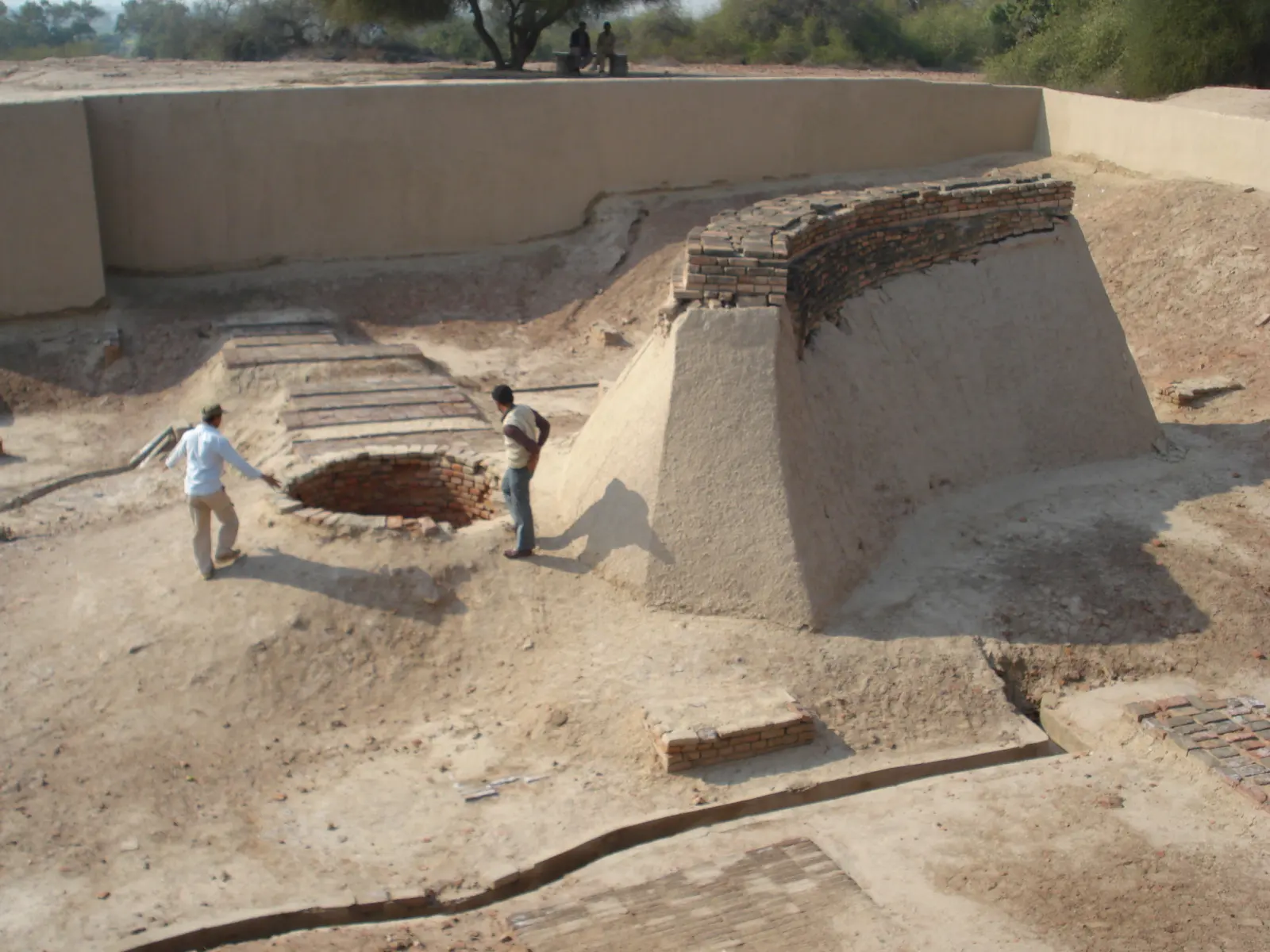
Harappa was a major settlement with a long history. Archaeological remains indicate different areas or mounds rather than a single simple rectangular city.
Excavations revealed substantial brick architecture, streets, drains, craft-working areas, seals, pottery, weights and other objects associated with Harappan urban life.
Harappa is especially important because evidence from different parts of the site helps archaeologists study not only the Mature Harappan city but also changes before and after its major urban phase.
🏗️ The Famous 'Granary' at Harappa
One group of large brick structures at Harappa has traditionally been described in textbooks as a granary. This interpretation became famous and is still common in examination material.
However, students should understand an important archaeological caution: assigning a precise function to an ancient structure is difficult when decisive evidence is absent. Terms such as 'granary' may sometimes represent an archaeological interpretation rather than a label left by the Harappans themselves.
For exams, remember that Harappa is traditionally associated with large structures described as granaries, but do not assume that every traditional building name represents a completely certain function.
⚒️ Craft and Everyday Life at Harappa
Archaeological finds from Harappa include pottery, seals, beads, tools, ornaments and standardized weights. Together they provide evidence for specialized crafts and organized exchange.
Residential and working areas also remind us that an ancient city was not only a collection of impressive public buildings. Thousands of people lived, worked, produced goods and interacted within these settlements.
🏛️ Mohenjo-daro: A Remarkably Preserved Urban Centre
Mohenjo-daro is one of the most famous and extensively studied Harappan cities. Its surviving remains provide a striking picture of urban planning during the third millennium BCE.
The archaeological site is generally discussed in terms of a higher western mound, often called the citadel, and an extensive lower town. The term 'citadel' is a modern archaeological label and should not automatically be understood as proof of a royal fortress.
Streets, houses, wells and drains show that water supply and wastewater management formed an important part of urban life.
💧 The Great Bath of Mohenjo-daro
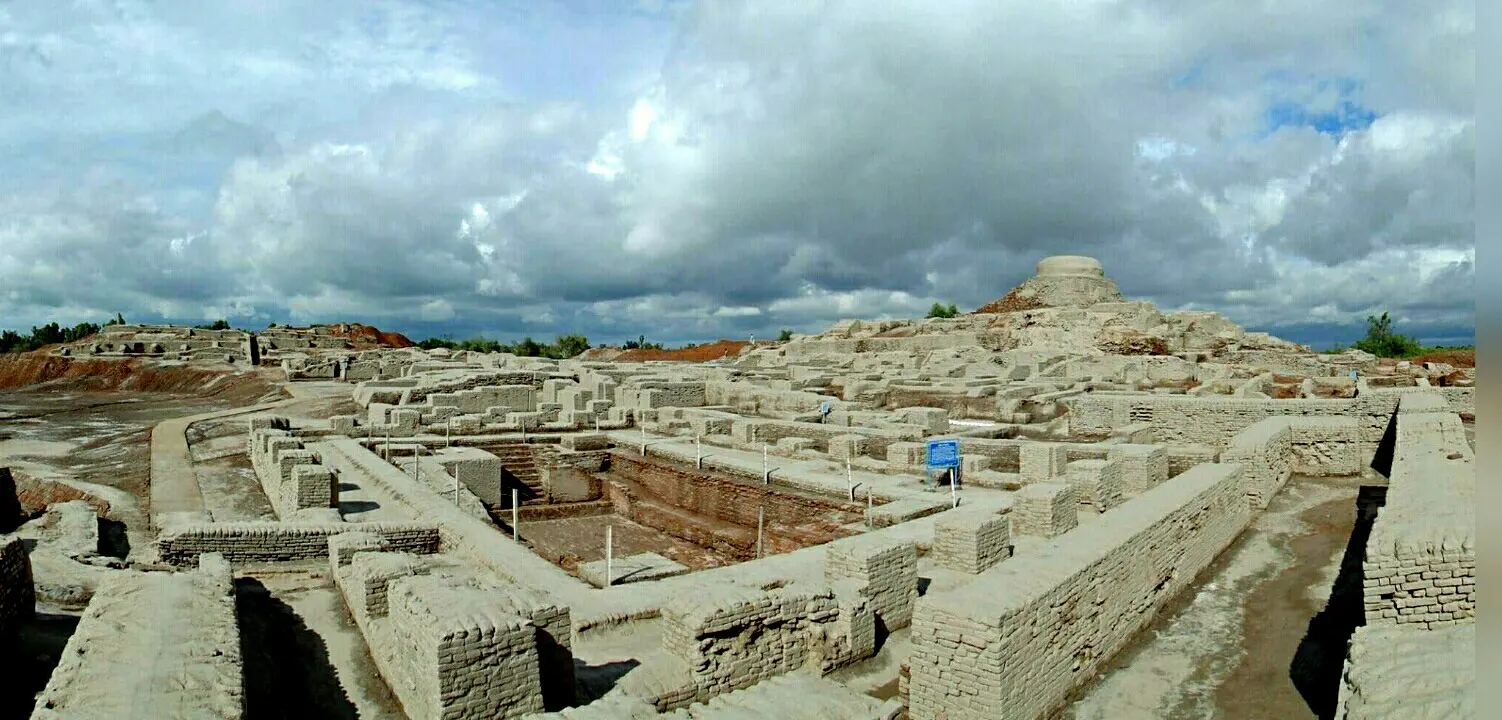
The most famous structure at Mohenjo-daro is the Great Bath. It consists of a large carefully constructed brick-lined tank surrounded by rooms and architectural features.
Its construction was designed to control water and reduce leakage. Stairs allowed access to the tank, and the overall arrangement indicates that this was not an ordinary household bathing space.
Its exact purpose cannot be proved because the Harappan script remains undeciphered. Archaeologists often suggest that it may have been used for some form of special, collective or ritual bathing, but this remains an interpretation rather than a written Harappan explanation.
🏢 The So-Called Granary or Great Hall
Near the Great Bath is another massive structure that older archaeological literature often called a granary.
Modern reassessment has raised doubts about this identification because clear evidence such as stored grain or associated storage containers was not found. Some archaeologists therefore prefer a more neutral description such as a Great Hall.
This is a useful lesson in archaeology: the ruins remain the same, but interpretations can change when evidence is reconsidered.
🏠 Houses Were an Important Part of City Planning
Many Harappan houses were constructed around internal spaces or courtyards. Rooms opened toward these internal areas, while access from major streets could be relatively controlled.
Some houses had bathing areas, and wastewater could pass through small drains into larger street drainage systems.
The houses were not all the same size. This variation suggests differences among households, although architecture alone cannot tell us the exact social rank or occupation of every resident.
🚰 Wells and Water
Mohenjo-daro is especially notable for its numerous wells. Access to water within the urban settlement reduced dependence on a single distant source.
The combination of wells, bathing areas and drains shows that Harappan builders paid serious attention to the movement of water through the city.
The wider subject of Harappan town planning and water management deserves separate treatment; here the key point is that both cities display organized urban infrastructure.
🛣️ Streets and Drainage
At Mohenjo-daro, streets and lanes were arranged in an orderly pattern, with many routes meeting at or near right angles. Drains were incorporated into the built environment.
Wastewater from houses could enter smaller channels and then larger drains. Access points and removable coverings in some drainage arrangements would have made maintenance possible.
It would be an exaggeration to imagine a modern sewer system, but for a Bronze Age city the attention given to drainage was remarkable.
🧱 Standardized Bricks
One of the striking features of Mature Harappan settlements is the widespread use of bricks made according to standardized proportions.
Such consistency across distant settlements suggests shared construction traditions and systems of measurement. It does not by itself prove that one emperor controlled every city, but it does show strong cultural and technical connections across the Harappan world.
🔍 Harappa and Mohenjo-daro: What Was Similar?
- Both were major centres of the Mature Harappan urban tradition.
- Both used brick architecture extensively.
- Both show organized streets and drainage arrangements.
- Both produced characteristic Harappan seals, pottery and other artefacts.
- Standardized weights and material traditions connect them with the wider Harappan world.
- Neither has provided a securely identified royal palace or royal tomb comparable to those known from some contemporary civilizations.
⚖️ What Was Different?
Mohenjo-daro is especially famous for the Great Bath, its numerous wells and its extensively preserved urban remains.
Harappa gave its name to the entire archaeological civilization and provides important evidence from several phases of settlement. It is also traditionally associated in textbooks with large brick structures described as granaries.
The differences remind us that Harappan civilization had shared traditions without requiring every city to have exactly the same buildings.
👑 Where Are the Kings and Palaces?
This is one of the most interesting questions raised by Harappa and Mohenjo-daro.
Archaeologists have not found an unquestionable royal palace, enormous royal tomb or clear written king-list like those known from some other ancient civilizations.
This does not mean that Harappan cities had no rulers, administrators or social hierarchy. It simply means that the available evidence does not allow us to reconstruct their political system with certainty.
This question will be examined separately when we study the political and social organization of the Indus Civilization.
🧠 Do Not Confuse the Two Cities
Harappa → Punjab region, civilization named after it, major multi-phase settlement, structures traditionally called granaries.
Mohenjo-daro → Sindh region, Great Bath, numerous wells, extensive urban remains.
⚠️ Common Exam Traps
- Great Bath = Mohenjo-daro, not Harappa.
- The civilization is called Harappan after the archaeological site of Harappa.
- Harappa and Mohenjo-daro are now both located in Pakistan.
- The word citadel is an archaeological description; it does not automatically prove the existence of a king's fortress.
- The identification of some large structures as granaries is not equally certain in every case.
- Similarity in bricks, weights and material culture shows strong standardization, but by itself does not prove a single centralized empire.
🎯 10-Second Revision
Harappa: Punjab → name of civilization → large brick structures traditionally called granaries.
Mohenjo-daro: Sindh → Great Bath → wells → impressive drainage and urban remains.
Both: Mature Harappan cities → bricks → streets → drainage → standardized material culture.
📌 The Big Idea
Harappa and Mohenjo-daro show that the Indus Civilization possessed a highly developed urban tradition. Their builders could organize streets, brick construction, water supply, drainage, craft production and large communal structures on an impressive scale.
But archaeology also teaches us to separate what the evidence clearly shows from what scholars infer from it. We can see the cities, drains, wells and buildings; the exact political system and the purpose of every large structure remain more difficult questions.
Was this article helpful?
Help us improve by giving your feedback.
Test your understanding
The Great Bath is associated with which Harappan city?
- A. Harappa
- B. Mohenjo-daro
- C. Lothal
- D. Kalibangan
The Great Bath is one of the most famous archaeological structures at Mohenjo-daro.
The Harappan Civilization takes its archaeological name from which site?
- A. Harappa
- B. Mohenjo-daro
- C. Dholavira
- D. Rakhigarhi
The archaeological culture is called Harappan after the site of Harappa.
Mohenjo-daro is located in which present-day region?
- A. Punjab, India
- B. Gujarat, India
- C. Sindh, Pakistan
- D. Punjab, India and Pakistan border
Mohenjo-daro is located in present-day Sindh province of Pakistan.
Which feature is particularly notable at Mohenjo-daro?
- A. A confirmed royal pyramid
- B. A deciphered royal archive
- C. A giant stone temple
- D. Numerous wells and organized drainage
Mohenjo-daro is notable for its numerous wells and extensive arrangements for drainage and sanitation.
Why should the traditional identification of some large Harappan structures as 'granaries' be treated cautiously?
- A. Harappans did not grow grain
- B. The precise function of such structures is not always supported by decisive archaeological evidence
- C. All granaries were made of stone
- D. The structures belong to the medieval period
Names such as 'granary' may reflect archaeological interpretation when decisive evidence for a building's exact function is lacking.
What does the widespread standardization of bricks and weights most safely indicate?
- A. Every Harappan city was designed by one architect
- B. A single known emperor ruled the entire civilization
- C. Shared systems and strong cultural or technical connections existed across Harappan settlements
- D. All Harappan houses were identical
Standardization indicates shared systems of measurement and strong cultural or technical connections, but does not by itself prove a single centralized empire.
Why should the term 'citadel' at Mohenjo-daro not automatically be interpreted as a royal fortress?
- A. It is a modern archaeological label and does not itself prove the presence of a king or royal fortress
- B. Mohenjo-daro had no elevated area
- C. The Harappans never used bricks
- D. The citadel was constructed in the nineteenth century
The term 'citadel' describes an elevated archaeological sector; the label alone does not demonstrate that it was a royal fortress.
Which conclusion about Harappan political organization is best supported by the evidence from Harappa and Mohenjo-daro?
- A. They were certainly ruled by one emperor whose name is known
- B. They definitely had no rulers or administrators
- C. Each city was ruled by an Egyptian pharaoh
- D. Urban organization is clear, but the exact form of political authority remains uncertain
The cities show substantial organization, but the absence of deciphered political texts and unambiguous royal monuments makes the exact political system difficult to reconstruct.