
Crafts, Trade, Weights and Measures in the Indus Civilization
Crafts, Trade, Weights and Measures in the Indus Civilization
Harappan cities supported highly skilled craftspeople and wide trade networks. Beads, shell objects, pottery, metals and standardized weights reveal both specialized production and strong systems of exchange within the Indus world and beyond.
Quick Summary
Harappan cities supported highly skilled craftspeople and wide trade networks. Beads, shell objects, pottery, metals and standardized weights reveal both specialized production and strong systems of exchange within the Indus world and beyond.
☷ Table of Contents ⌃
- 1⚒️ Cities Needed More Than Farmers
- 2🔴 Bead-Making Was a Skilled Craft
- 3🏭 Craft Centres and Specialized Production
- 4🐚 Shell, Ivory and Bone Crafts
- 5🔥 Pottery and Everyday Production
- 6🔨 Copper and Bronze
- 7🧭 Raw Materials Came from Far Away
- 8⚖️ Standardized Weights
- 9📏 What About Measures of Length?
- 10🏘️ Trade Within the Harappan World
- 11🌊 Long-Distance Trade Beyond the Indus Region
- 12🚢 What Did the Harappans Export?
- 13🪙 Was There Harappan Coinage?
- 14🔐 Seals and Trade
- 15🧠 What Does Standardization Tell Us?
- 16⚠️ Common Exam Traps
- 17🎯 10-Second Revision
- 18📌 The Big Idea
⚒️ Cities Needed More Than Farmers
The Indus Civilization was supported not only by farming but also by a large world of craft production and trade. Archaeologists have found beads, pottery, shell objects, metal tools, ornaments, seals and standardized weights at many Harappan sites.
These objects show that some people became highly skilled in particular crafts. Raw materials often came from distant places, so craftspeople and traders depended on wide networks connecting villages, towns, cities and regions beyond the Indus world.
🔴 Bead-Making Was a Skilled Craft
Beads are among the most impressive Harappan craft products. They were made from materials such as carnelian, agate, steatite, shell, faience and terracotta.
Carnelian beads required several stages of work. Stone had to be selected, shaped, polished and drilled. Long beads were especially difficult to make because drilling through a hard stone without breaking it required great skill.
Harappan-style carnelian beads have also been found far outside the Indus region, including at Mesopotamian sites. This is strong evidence that some Harappan craft products travelled through long-distance trade.
🏭 Craft Centres and Specialized Production
Some Harappan settlements appear to have been important centres of specialized production. Chanhudaro is well known for bead-making and other crafts, while Lothal is associated with bead production, shell working and exchange.
Craft specialization means that every household did not necessarily produce every object it needed. Some people could spend much of their time making beads, pottery, metal goods or shell objects and obtain food or other necessities through exchange.
🐚 Shell, Ivory and Bone Crafts
Shell objects were made into bangles, decorative pieces and other items. Because marine shells came from coastal areas, their presence at inland sites shows movement of raw materials over considerable distances.
Bone and ivory were also worked into tools, ornaments and small objects. Different crafts required different skills, tools and access to raw materials.
🔥 Pottery and Everyday Production
Pottery was one of the most common Harappan crafts. Pots served practical purposes such as cooking, storage and serving food, but some were also carefully painted or decorated.
The potter's wheel and controlled firing allowed production of well-shaped vessels. Pottery styles help archaeologists identify cultural phases and compare settlements across regions.
🔨 Copper and Bronze
Harappan metalworkers used copper and bronze to make tools, vessels, ornaments and small objects. Copper ores were not available everywhere, so metal production depended on obtaining raw materials from mining regions through exchange networks.
Gold and silver were also used for ornaments, though such materials were naturally rarer and likely more valuable.
🧭 Raw Materials Came from Far Away
The Harappan world was connected to many sources of raw materials. Different stones, metals and shells had to be moved from the places where they occurred naturally to workshops and cities where they were processed.
Carnelian was associated especially with regions such as Gujarat. Marine shells came from coastal zones. Copper could come from several mining regions, while lapis lazuli reached wider trade systems from areas much farther northwest.
This means that a finished Harappan bead or ornament could represent the work of many people across several regions.
⚖️ Standardized Weights
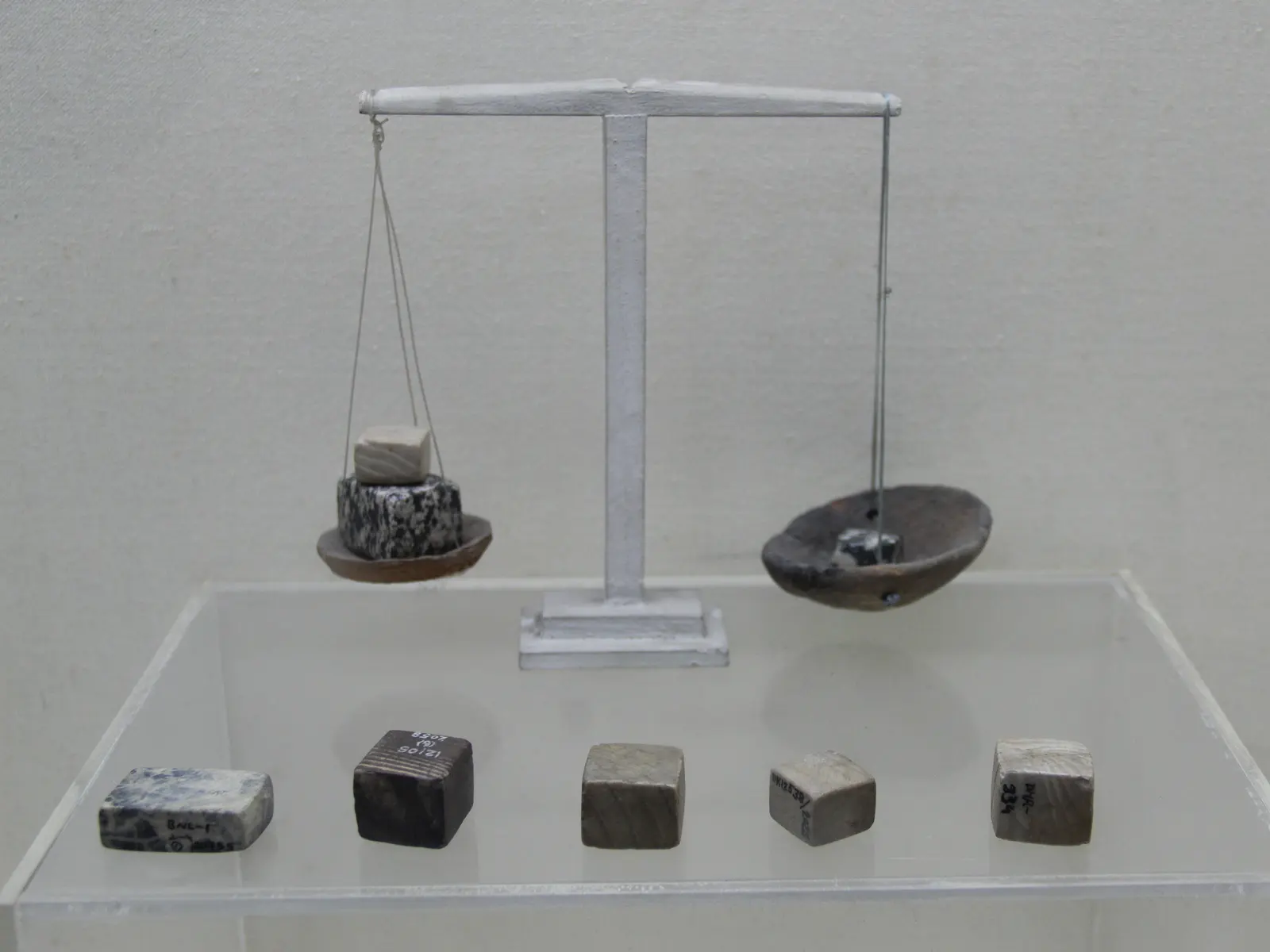
One of the most striking features of Harappan trade is the use of standardized stone weights. Many are small cubical pieces made from carefully selected stone.
Their values followed consistent patterns, showing that weighing was not done randomly. Standard weights would have been extremely useful when exchanging valuable materials such as metals, stones, beads or other goods.
The presence of similar weight systems at widely separated Harappan settlements suggests strong shared commercial practices.
📏 What About Measures of Length?
Archaeologists have also found objects interpreted as measuring scales or rulers. The best-known examples suggest that Harappan craftspeople used regular units for precise work.
This kind of measurement would have been useful in construction, craft production and exchange. However, we should be careful about claiming that every Harappan city used every measurement in exactly the same way.
🏘️ Trade Within the Harappan World
Most trade probably took place within the civilization itself. Cities needed grain, animals, timber, stone, metal and craft goods from surrounding regions.
Villages could supply food and raw materials; craft centres could supply finished products; cities could serve as large markets and centres of exchange.
River routes, overland paths and coastal connections all helped move goods.
🌊 Long-Distance Trade Beyond the Indus Region
Harappan objects and related materials have been found in regions connected with the Persian Gulf and Mesopotamia. Mesopotamian texts mention places called Meluhha, Magan and Dilmun. Many historians identify Meluhha with the Indus region, although ancient geographical names must always be interpreted carefully.
Indus-style seals and carnelian beads found in Mesopotamia and Gulf regions support the existence of long-distance exchange.
Trade may have moved through both sea routes and overland routes. Gujarat's coastal settlements were especially well placed to participate in maritime exchange.
🚢 What Did the Harappans Export?
Archaeological evidence suggests that goods moving outward from the Indus region included carnelian beads, shell products and possibly other craft goods and raw materials.
In return, the Harappan world could obtain materials that were scarce locally. But because no Harappan trade records can yet be read, exact lists of imports and exports should be treated cautiously.
🪙 Was There Harappan Coinage?
No confirmed coinage system is known from the Harappan Civilization. Trade therefore did not depend on coins in the later historical sense.
Goods could be exchanged directly or valued through weighed quantities. Standardized weights would have made such transactions easier.
This is an important exam distinction: standard weights do not mean coins.
🔐 Seals and Trade
Harappan seals are often connected with exchange and administration. A seal could create an impression on clay, possibly helping identify a person, group, goods or transaction.
However, because the Indus script remains undeciphered, we cannot say exactly what every seal meant. Their role in trade is highly plausible, but specific interpretations must remain cautious.
🧠 What Does Standardization Tell Us?
Similar weights, seals, brick proportions and craft techniques across distant settlements show a remarkable level of cultural coordination.
But this does not automatically prove that one emperor controlled every workshop and marketplace. Standardization could spread through shared traditions, institutions, trade practices and networks.
⚠️ Common Exam Traps
- Carnelian beads were a famous Harappan craft product.
- Chanhudaro is strongly associated with craft and bead production.
- Lothal is important for crafts and trade connections.
- Harappans used standardized weights, but no confirmed system of coins is known.
- Mesopotamian texts mention Meluhha, commonly linked by historians with the Indus region.
- Long-distance trade existed, but most daily exchange was probably within the wider Harappan network itself.
- Standardization shows shared practices; it does not by itself prove one centralized empire.
🎯 10-Second Revision
Crafts: beads + pottery + shell + metal.
Trade: internal networks + Persian Gulf + Mesopotamia.
Weights: standardized stone cubes.
Important centres: Chanhudaro + Lothal.
📌 The Big Idea
Harappan trade worked because crafts, raw materials and measurement systems were connected. A bead could begin as stone from one region, be shaped by a specialist in another settlement and finally travel hundreds or even thousands of kilometres.
The standardized weights and widespread craft traditions show that the Indus Civilization was not a group of isolated cities. It was a deeply connected economic world.
Was this article helpful?
Help us improve by giving your feedback.
Test your understanding
Which material was especially famous in Harappan bead-making?
- A. Marble
- B. Carnelian
- C. Coal
- D. Granite
Carnelian was widely used by Harappan craftspeople to make high-quality beads, some of which also travelled through long-distance trade.
Which Harappan settlement is especially associated with bead-making and specialized crafts?
- A. Chanhudaro
- B. Alamgirpur
- C. Kalibangan
- D. Ropar
Chanhudaro is well known for archaeological evidence of bead-making and specialized craft production.
What did Harappans use to make the weighing of goods more consistent?
- A. Paper currency
- B. Gold coins
- C. Standardized stone weights
- D. Printed price labels
Harappans used carefully made standardized stone weights, which helped create consistent systems of weighing across settlements.
Which statement about Harappan coinage is most accurate?
- A. Harappans used silver rupees
- B. Each city minted its own gold coins
- C. Harappan coins carried readable royal names
- D. No confirmed coinage system is known from the Harappan Civilization
Standardized weights are known, but there is no confirmed Harappan coinage system comparable to later historical currencies.
The Mesopotamian name 'Meluhha' is commonly linked by historians with which region?
- A. Ancient Egypt
- B. The Indus region
- C. Ancient Greece
- D. Northern China
Many historians connect Meluhha in Mesopotamian texts with the Indus region, although ancient geographical names must be interpreted carefully.
Why are marine shell objects found at inland Harappan settlements important?
- A. They prove the cities were all underwater
- B. They show shell was manufactured from clay
- C. They indicate movement of raw materials from coastal areas through trade
- D. They prove every Harappan was a sailor
Marine shells originated in coastal zones, so their presence inland shows that raw materials moved through exchange networks.
What is the safest conclusion from similar standardized weights found across distant Harappan settlements?
- A. Shared systems of measurement and exchange operated across the Harappan world
- B. One known emperor personally weighed every transaction
- C. All trade occurred only with Mesopotamia
- D. Harappans did not practise local exchange
Similar standardized weights across many settlements show strong shared measurement and commercial practices, but they do not by themselves reveal the exact political system.
Why are Harappan carnelian beads found at Mesopotamian sites important?
- A. They prove Mesopotamians founded Harappa
- B. They show carnelian existed only in Mesopotamia
- C. They prove all Harappans migrated west
- D. They provide archaeological evidence for long-distance exchange between the Indus region and western Asia
Harappan-style carnelian beads found in Mesopotamia demonstrate that craft goods from the Indus world travelled through long-distance exchange networks.