
The Life of Gautama Buddha
The Life of Gautama Buddha
Siddhartha Gautama was a historical religious teacher associated with the Shakya community. Buddhist tradition connects his birth with Lumbini, enlightenment with Bodh Gaya, first sermon with Sarnath and Mahaparinirvana with Kushinagar. His path rejected both sensual indulgence and extreme self-mortification in favour of the Middle Way.
Quick Summary
Siddhartha Gautama was a historical religious teacher associated with the Shakya community. Buddhist tradition connects his birth with Lumbini, enlightenment with Bodh Gaya, first sermon with Sarnath and Mahaparinirvana with Kushinagar. His path rejected both sensual indulgence and extreme self-mortification in favour of the Middle Way.
☷ Table of Contents ⌃
- 1🪷 Who Was Gautama Buddha?
- 2⚠️ Dates
- 3🌳 Birth at Lumbini
- 4👨👩👦 Family
- 5👑 Shakya Political World
- 6🤔 The Search for an End to Suffering
- 7🚶 Great Renunciation
- 8🧠 Teachers and Meditation
- 9🔥 Extreme Asceticism
- 10⚖️ The Middle Way
- 11✨ Enlightenment at Bodh Gaya
- 12🦌 First Sermon at Sarnath
- 13👥 The Sangha
- 14☸️ Three Jewels
- 15🚶 Teaching Career
- 16👑 Political Patrons
- 17👩 Women in the Sangha
- 18🗣️ Language
- 19🕊️ Nirvana and Mahaparinirvana
- 20🌳 Kushinagar
- 214️⃣ Four Principal Sites
- 22📜 Preservation of the Teachings
- 23📌 The Big Idea
🪷 Who Was Gautama Buddha?
Gautama Buddha was one of the most influential religious teachers of ancient South Asia.
He is traditionally known by the birth name Siddhartha Gautama and was associated with the Shakya community.
After awakening or enlightenment he became known as the Buddha, broadly meaning the Awakened One.
⚠️ Dates
The exact dates of the Buddha's life remain debated. Older traditional chronologies often give dates such as 563–483 BCE, while modern scholarship offers different reconstructions.
It is therefore safest to place him broadly in the sixth-fifth century BCE historical environment rather than present one exact chronology as universally certain.
🌳 Birth at Lumbini
Buddhist tradition identifies Lumbini in present-day Nepal as the Buddha's birthplace.
An inscription on the pillar erected there by Emperor Ashoka in the third century BCE provides especially important historical evidence for the site's identification.
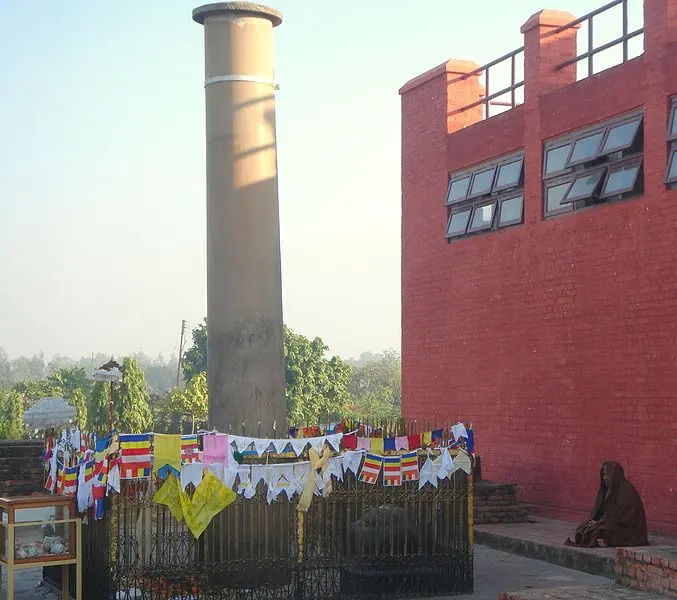
The pillar is several centuries later than the Buddha and should not be mistaken for a monument from his lifetime.
👨👩👦 Family
Buddhist traditions name Siddhartha's father as Suddhodana and his mother as Maya or Mahamaya. His upbringing is closely associated with Mahapajapati Gotami after Maya's early death.
Traditional biographies also associate him with Yasodhara and their son Rahula.
👑 Shakya Political World
Siddhartha is commonly called a prince, but the Shakyas belonged to a clan-based political environment. It is therefore better not to imagine their polity simply as a large centralised monarchy of the later type.
🤔 The Search for an End to Suffering
The central problem behind Siddhartha's spiritual quest was the reality of ageing, illness, death and suffering.
Later Buddhist biographies express this through the famous story of the Four Sights: an old person, a sick person, a corpse and a renunciant.
🚶 Great Renunciation
Tradition states that Siddhartha left household life at about the age of twenty-nine and became a wandering seeker.
🧠 Teachers and Meditation
Early Buddhist traditions associate him with teachers including Alara Kalama and Uddaka Ramaputta. He mastered advanced contemplative states but concluded that they did not provide final liberation.
🔥 Extreme Asceticism
Siddhartha then practised severe austerity and fasting. Eventually he rejected extreme self-mortification as ineffective.
⚖️ The Middle Way
This experience became central to the Buddhist Middle Way, avoiding both sensual indulgence and destructive self-mortification.
✨ Enlightenment at Bodh Gaya
Siddhartha's awakening is traditionally located at Bodh Gaya beneath the Bodhi Tree.
After enlightenment he became the Buddha.
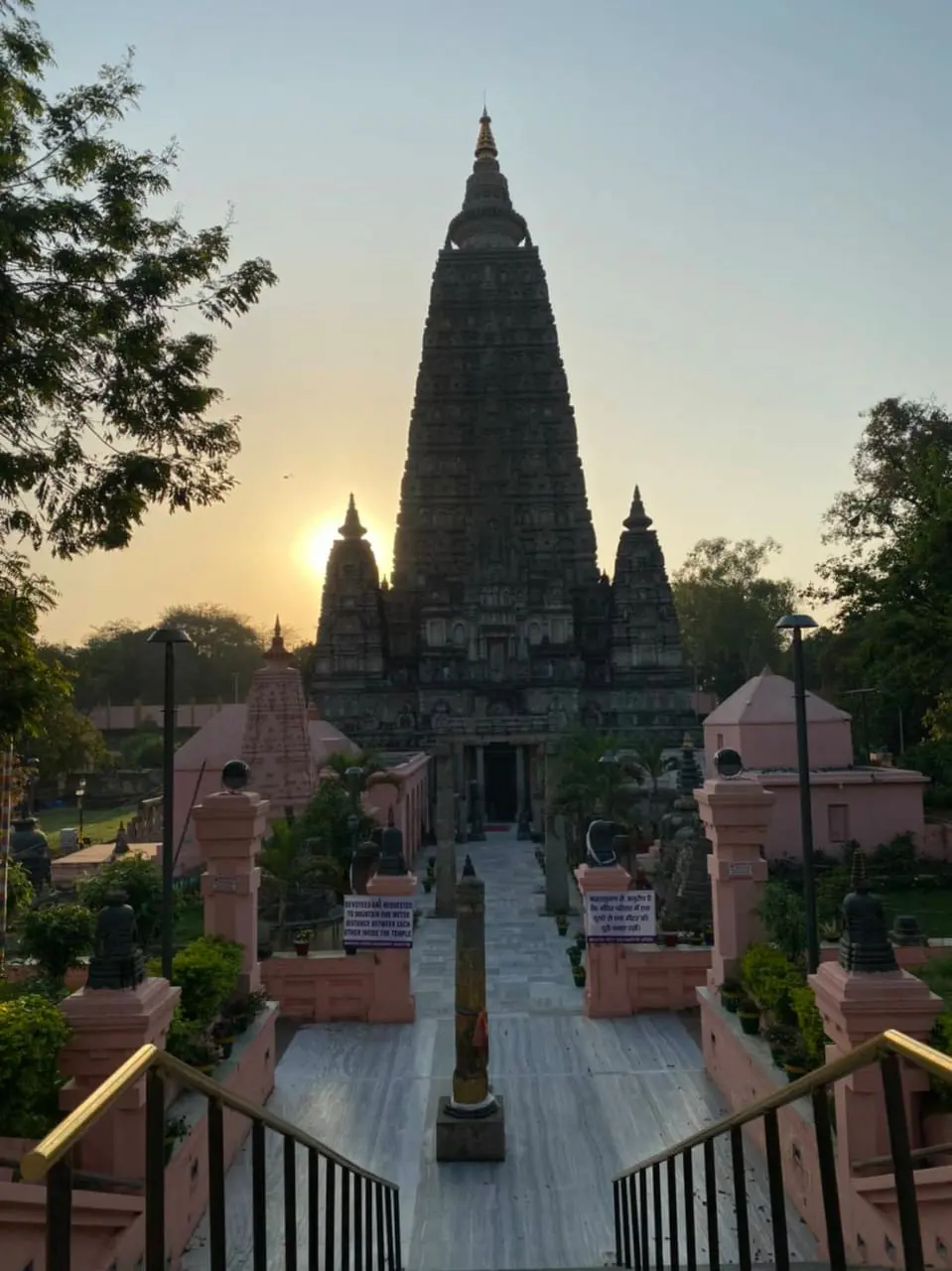
The present Mahabodhi Temple is much later than the Buddha. UNESCO dates the standing temple substantially to the fifth-sixth centuries CE, while Ashoka had established an earlier shrine at the site in the third century BCE.
🦌 First Sermon at Sarnath
After enlightenment, the Buddha travelled to Sarnath near Varanasi and taught the five ascetics who had previously accompanied him.
The first sermon is traditionally known as the Dhammacakkappavattana, or Setting in Motion the Wheel of Dhamma.
It is closely associated with the Middle Way, Four Noble Truths and Eightfold Path.
👥 The Sangha
The community of disciples developed into the Buddhist Sangha. Over time, communities of monks and nuns grew alongside large networks of lay followers.
☸️ Three Jewels
The Buddhist Three Jewels are Buddha, Dhamma and Sangha.
These should not be confused with the Jain Three Jewels of Right Faith, Right Knowledge and Right Conduct.
🚶 Teaching Career
Buddhist tradition gives the Buddha a teaching career of roughly forty-five years across the Gangetic region.
Rajagriha, Shravasti, Vaishali and Kosambi appear frequently in early Buddhist literature.
👑 Political Patrons
Buddhist texts associate the Buddha with rulers including Bimbisara, Ajatashatru and Pasenadi of Kosala.
Merchants and householders such as Anathapindika and Visakha were also important supporters.
👩 Women in the Sangha
Mahapajapati Gotami is traditionally associated with the establishment of the community of Buddhist nuns.
Women therefore participated in Buddhist renunciant life, although monastic institutions did not operate with complete modern gender equality.
🗣️ Language
It is safest to say that the Buddha's teachings circulated in the Middle Indo-Aryan vernacular environment rather than claim that every original sermon was delivered in the exact standard form later known as Pali.
The Theravada canon was subsequently preserved in Pali.
🕊️ Nirvana and Mahaparinirvana
Nirvana should not simply be equated with death. Buddhist tradition regards the Buddha as having realised Nirvana through enlightenment.
His final passing is specifically described as Mahaparinirvana.
🌳 Kushinagar
The Buddha's final passing is traditionally associated with Kushinara, modern Kushinagar.
After his cremation, traditions describe the distribution of relics and the construction of stupas over them.
4️⃣ Four Principal Sites
Lumbini → Birth.
Bodh Gaya → Enlightenment.
Sarnath → First sermon.
Kushinagar → Mahaparinirvana.
📜 Preservation of the Teachings
No surviving book is known to have been written personally by the Buddha. His teachings were preserved orally by disciples and later organised into Buddhist canonical traditions.
📌 The Big Idea
The Buddha's life is best understood as a search for an answer to suffering. He rejected both luxury and extreme self-torture, attained awakening at Bodh Gaya and taught a Middle Way centred on disciplined understanding and practice.
Was this article helpful?
Help us improve by giving your feedback.
Test your understanding
Which place is traditionally associated with the birth of Gautama Buddha?
- A. Sarnath
- B. Lumbini
- C. Bodh Gaya
- D. Kushinagar
Buddhist tradition associates the Buddha's birth with Lumbini, whose identification is importantly supported by an Ashokan pillar inscription.
Where is Siddhartha Gautama traditionally believed to have attained enlightenment?
- A. Vaishali
- B. Rajagriha
- C. Bodh Gaya
- D. Shravasti
Buddhist tradition associates Siddhartha's enlightenment with Bodh Gaya.
Which place is associated with the Buddha's first sermon?
- A. Sarnath
- B. Lumbini
- C. Kushinagar
- D. Champa
The Buddha's first sermon is traditionally associated with the Deer Park at Sarnath.
Which place is associated with the Buddha's Mahaparinirvana?
- A. Taxila
- B. Ujjayini
- C. Kaushambi
- D. Kushinagar
Buddhist tradition associates the Buddha's Mahaparinirvana with Kushinagar.
The Buddhist Middle Way avoids which two extremes?
- A. Agriculture and trade
- B. Sensual indulgence and extreme self-mortification
- C. Knowledge and conduct
- D. Monarchy and gana-sangha
The Middle Way rejects both sensual indulgence and severe self-mortification.
What are the Buddhist Three Jewels?
- A. Ahimsa, Satya and Asteya
- B. Brahma, Vishnu and Shiva
- C. Buddha, Dhamma and Sangha
- D. Faith, Knowledge and Conduct
The Buddhist Three Jewels are Buddha, Dhamma and Sangha. Right Faith, Knowledge and Conduct form the Jain Three Jewels.
Which is the most historically careful statement about dates such as 563–483 BCE for the Buddha?
- A. They represent a traditional chronology, while exact historical dating remains debated
- B. They are exact dates proven by archaeology
- C. All Buddhist traditions and modern historians agree on them
- D. They are the dates of Ashoka's reign
The Buddha's absolute chronology remains debated, so such dates should be identified as traditional rather than universally certain.
How should the present Mahabodhi Temple best be understood as evidence for the Buddha's life?
- A. The Buddha personally commissioned it
- B. It is exactly the building in which the Buddha lived
- C. It has remained completely unchanged since the Mauryan period
- D. It is later architecture at the sacred enlightenment site; the location tradition is ancient, but the standing temple is not from the Buddha's lifetime
Bodh Gaya has an ancient association with the Buddha's enlightenment, but the present Mahabodhi Temple is a much later structure.