
The Sixteen Mahajanapadas
The Sixteen Mahajanapadas
By around the sixth century BCE, a number of large territorial states known as Mahajanapadas had emerged across northern India and adjoining regions. The Anguttara Nikaya preserves a famous list of sixteen. Magadha, Kosala, Vatsa and Avanti became major powers, while polities such as Vajji followed forms of gana-sangha political organisation.
Quick Summary
By around the sixth century BCE, a number of large territorial states known as Mahajanapadas had emerged across northern India and adjoining regions. The Anguttara Nikaya preserves a famous list of sixteen. Magadha, Kosala, Vatsa and Avanti became major powers, while polities such as Vajji followed forms of gana-sangha political organisation.
☷ Table of Contents ⌃
- 1👑 From Janapadas to Mahajanapadas
- 2🤔 What Was a Janapada?
- 3📜 Where Does the List of Sixteen Come From?
- 4🗺️ The Sixteen
- 5⚠️ A Note About Historical Maps
- 6🌾 Anga
- 7🐘 Magadha
- 8🛕 Kasi
- 9🏹 Kosala
- 10🤝 Vajji
- 11⚔️ Malla
- 12🌿 Chedi
- 13🏙️ Vatsa
- 14📜 Kuru
- 15🏹 Panchala
- 16🐟 Matsya
- 17🛕 Surasena
- 18🌴 Assaka/Asmaka
- 19⚔️ Avanti
- 20🌍 Gandhara
- 21🐎 Kamboja
- 22👑 Were All Mahajanapadas Monarchies?
- 23⭐ Four Major Powers
- 24🌾 Resources and Political Power
- 25🧘 Connection with Buddhism and Jainism
- 26🎯 Quick Revision
- 27📌 The Big Idea
👑 From Janapadas to Mahajanapadas
During the first millennium BCE, political organisation changed along with agriculture, trade and urban growth. Larger territorial states emerged from an earlier landscape of Janapadas.
These larger political units came to be known as Mahajanapadas.
🤔 What Was a Janapada?
A Janapada can broadly be understood as the territorial base associated with a jana or community. Over time, political identity became increasingly connected with defined territories rather than kinship alone.
📜 Where Does the List of Sixteen Come From?
A famous list of sixteen Mahajanapadas occurs in the Buddhist Anguttara Nikaya. Other Buddhist and Jain traditions preserve lists with some differences, so the number sixteen should be understood in its textual context.
🗺️ The Sixteen
- Anga
- Magadha
- Kasi
- Kosala
- Vajji
- Malla
- Chedi
- Vatsa
- Kuru
- Panchala
- Matsya
- Surasena
- Assaka/Asmaka
- Avanti
- Gandhara
- Kamboja
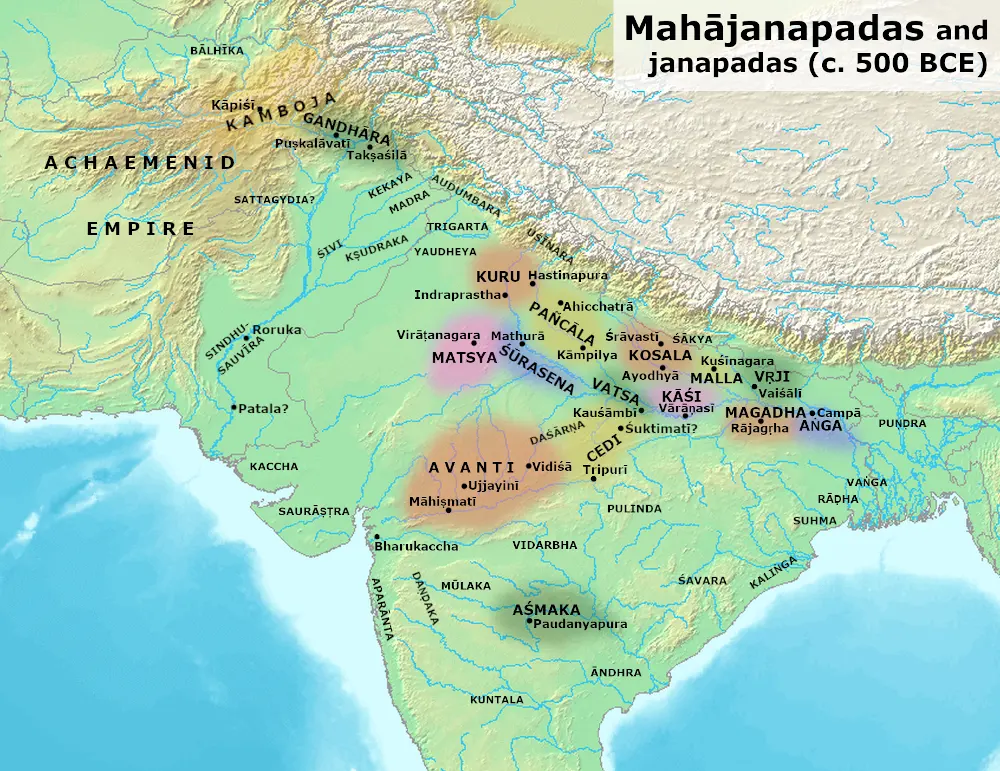
⚠️ A Note About Historical Maps
The boundaries shown on modern maps of ancient states are approximate reconstructions. Ancient political frontiers were not necessarily fixed borders comparable to those of modern nation-states.
🌾 Anga
Anga was an important eastern Mahajanapada. Champa was its famous capital and commercial centre. Bimbisara of Magadha eventually conquered Anga.
🐘 Magadha
Magadha emerged as the most successful Mahajanapada. Its early core lay broadly in southern Bihar. Rajagriha was an early capital, while Pataliputra later became a major political centre.
🛕 Kasi
Kasi was centred on Varanasi. It was an important and prosperous state and became involved in political rivalry with Kosala.
🏹 Kosala
Kosala was one of the major powers of northern India. Shravasti was an important political centre, while Saketa/Ayodhya was another important city in the region. Pasenadi or Prasenajit was a prominent ruler during the Buddha's lifetime.
🤝 Vajji
Vajji was centred in north Bihar, with Vaishali as an important centre. It was associated with a confederate or gana-sangha political system in which clans such as the Licchavis were important.
⚔️ Malla
Malla was also associated with gana-sangha political organisation. Kushinara and Pava were important centres. Kushinara has special importance in Buddhist tradition as the place associated with the Buddha's Mahaparinirvana.
🌿 Chedi
Chedi was located broadly in parts of central India and is often associated with the Bundelkhand region. Its precise political extent should not be treated as a fixed modern boundary.
🏙️ Vatsa
Vatsa had its important capital at Kaushambi near the Yamuna. Its position helped make it an important urban and commercial centre. Udayana is a famous ruler associated with Vatsa.
📜 Kuru
Kuru was broadly associated with parts of the Delhi-Haryana-western Uttar Pradesh region. Although especially prominent in earlier Vedic history, its cultural importance continued into the Mahajanapada period.
🏹 Panchala
Panchala was associated broadly with parts of western and central Uttar Pradesh. Northern and southern divisions of Panchala are known, with centres such as Ahichchhatra and Kampilya.
🐟 Matsya
Matsya was broadly located in northeastern Rajasthan. Viratanagara is traditionally associated with its capital.
🛕 Surasena
Surasena was centred on Mathura, whose strategic location later helped it remain an important centre of trade, culture and religion.
🌴 Assaka/Asmaka
Assaka or Asmaka is particularly notable because it was associated with the Godavari region, south of the main northern cluster of Mahajanapadas.
⚔️ Avanti
Avanti was a major power of western-central India. Ujjayini and Mahishmati were important centres. Pradyota is a prominent ruler associated with Avanti.
🌍 Gandhara
Gandhara occupied an important northwestern position, broadly covering parts of present-day northwestern Pakistan and adjoining areas. Taxila was its famous centre and was well placed on routes connecting South Asia with regions to the northwest.
🐎 Kamboja
Kamboja was associated with the northwestern frontier. Its exact geographical identification remains debated, so it should not be reduced to a single modern district.
👑 Were All Mahajanapadas Monarchies?
No. Many were monarchies, but some followed forms of gana-sangha political organisation. Vajji and Malla are famous examples.
⭐ Four Major Powers
Among the Mahajanapadas, Magadha, Kosala, Vatsa and Avanti became particularly important in political competition.
Eventually Magadha outgrew its rivals and became the dominant power.
🌾 Resources and Political Power
Larger states required resources to support armies, officials and fortifications. Agricultural surplus, revenue, trade and control over strategically important regions therefore became increasingly significant.
🧘 Connection with Buddhism and Jainism
The Mahajanapada period formed the broader political and social setting in which Mahavira and the Buddha lived. Magadha, Kosala, Vajji and Malla appear repeatedly in Jain and Buddhist traditions.
🎯 Quick Revision
Famous list → Anguttara Nikaya.
Total → 16.
Anga → Champa.
Magadha → Rajagriha; later Pataliputra.
Kasi → Varanasi.
Kosala → Shravasti important centre.
Vajji → Vaishali; gana-sangha/confederacy.
Malla → Kushinara and Pava.
Vatsa → Kaushambi.
Surasena → Mathura.
Avanti → Ujjayini and Mahishmati.
Gandhara → Taxila.
Assaka → Godavari region.
Major competing powers → Magadha, Kosala, Vatsa and Avanti.
📌 The Big Idea
The Sixteen Mahajanapadas represent an important phase in the development of larger territorial political systems. They were not all governed in the same way: monarchies existed alongside gana-sangha polities.
Competition among these states eventually favoured Magadha, whose rise transformed the political history of northern India.
Was this article helpful?
Help us improve by giving your feedback.
Test your understanding
Which Buddhist text contains the famous list of sixteen Mahajanapadas?
- A. Dhammapada
- B. Anguttara Nikaya
- C. Milindapanha
- D. Buddhacharita
The famous list of sixteen Mahajanapadas occurs in the Anguttara Nikaya.
What was the famous capital of Anga?
- A. Ujjayini
- B. Taxila
- C. Champa
- D. Mathura
Champa was the famous capital and an important commercial centre of Anga.
Which was the famous centre of Gandhara?
- A. Taxila
- B. Vaishali
- C. Kaushambi
- D. Rajagriha
Taxila was the famous centre of Gandhara.
Which Mahajanapada was associated with the Godavari region?
- A. Kuru
- B. Gandhara
- C. Vajji
- D. Assaka/Asmaka
Assaka or Asmaka was associated with the Godavari region.
Vaishali was an important centre of which polity?
- A. Avanti
- B. Vajji
- C. Vatsa
- D. Matsya
Vaishali was an important centre of the Vajji confederacy.
Which four emerged as major competing powers among the Mahajanapadas?
- A. Kuru, Panchala, Matsya and Chedi
- B. Vajji, Malla, Gandhara and Kamboja
- C. Magadha, Kosala, Vatsa and Avanti
- D. Anga, Matsya, Surasena and Kamboja
Magadha, Kosala, Vatsa and Avanti became particularly important competing powers.
Which statement about the political organisation of the Mahajanapadas is most accurate?
- A. All had hereditary kings
- B. All were modern democracies
- C. All were Buddhist republics
- D. Some were monarchies while others had forms of gana-sangha organisation
Political organisation varied. Many Mahajanapadas were monarchies, while polities such as Vajji and Malla were associated with gana-sangha systems.
Which statement about modern historical maps of the Mahajanapadas is correct?
- A. Their boundaries are approximate reconstructions
- B. They are as exact as modern international borders
- C. Every boundary was completely marked by stone pillars
- D. All such maps were drawn by ancient rulers themselves
Modern historical maps reconstruct ancient political geography from available evidence, so their boundaries should be treated as approximate.