
The Indus Script and Harappan Seals
The Indus Script and Harappan Seals
The Indus Civilization used a still-undeciphered writing system found mainly on seals, tablets, pottery and other small objects. Harappan seals combine short inscriptions with animal motifs and probably played roles in identity, administration and exchange.
Quick Summary
The Indus Civilization used a still-undeciphered writing system found mainly on seals, tablets, pottery and other small objects. Harappan seals combine short inscriptions with animal motifs and probably played roles in identity, administration and exchange.
☷ Table of Contents ⌃
- 1✍️ A Writing System We Still Cannot Read
- 2🔤 What Does the Indus Script Look Like?
- 3📏 Why Are the Texts So Difficult to Decipher?
- 4🌍 No Bilingual Inscription Has Been Found
- 5🗣️ We Do Not Know the Underlying Language
- 6➡️ Which Direction Was the Script Written?
- 7🦄 Harappan Seals: Writing and Images Together
- 8🦄 What Is the Harappan 'Unicorn'?
- 9🔐 What Were Seals Used For?
- 10📦 Sealings and Trade
- 11🧱 Script Was Not Limited to Seals
- 12🪧 Dholavira's Large Signboard
- 13📜 Why Are There No Long Harappan Texts?
- 14🧠 Can We Call It an Alphabet?
- 15🔢 Were Some Signs Numbers?
- 16🔍 What Can We Learn Even Without Reading It?
- 17🧩 Why Decipherment Would Be Such a Big Breakthrough
- 18⚠️ Common Exam Traps
- 19🎯 10-Second Revision
- 20📌 The Big Idea
✍️ A Writing System We Still Cannot Read
One of the greatest mysteries of the Indus or Harappan Civilization is its writing system. Thousands of inscribed objects have been found, yet the meaning of the signs has not been securely deciphered.
The script appears mainly on small objects such as stone seals, seal impressions, tablets, pottery and other inscribed artefacts. Most inscriptions are extremely short. This is one of the main reasons decipherment has been so difficult.
We therefore know that the Harappans used a structured system of signs, but we cannot yet confidently read their personal names, titles, language or full messages.
🔤 What Does the Indus Script Look Like?
The script consists of hundreds of recurring signs. Some signs look pictorial, while others are more abstract. Researchers have produced different sign lists, so the exact number depends on how variants are counted.
Many studies identify roughly 400–500 distinct signs, including variants and compound forms.
The signs are not placed randomly. Statistical studies show regular patterns in which signs can appear at the beginning, middle or end of inscriptions. This is one reason many scholars consider the signs to represent a genuine writing or information system rather than simple decoration.
📏 Why Are the Texts So Difficult to Decipher?
The biggest problem is their short length. Harappan inscriptions often contain only a few signs, with an average of around five signs in many collections.
There are no long royal inscriptions, laws, stories or administrative tablets comparable to the large texts known from Mesopotamia or Egypt.
Short texts give researchers very little context. A sequence of five signs might represent a name, title, institution, commodity or something completely different.
🌍 No Bilingual Inscription Has Been Found
Another major difficulty is the absence of a bilingual inscription — a text written in both the Indus script and a known language.
The famous Rosetta Stone helped scholars decipher Egyptian hieroglyphs because the same message appeared in multiple scripts. No equivalent discovery has yet been made for the Indus script.
Without such a key, proposed readings are much harder to test.
🗣️ We Do Not Know the Underlying Language
Scholars have proposed several possibilities for the language behind the script. Some theories connect it with an early Dravidian language, while other proposals have suggested different language families.
But there is still no universally accepted decipherment. Claims that the Indus script has been completely read should therefore be treated with caution unless they can be independently tested and widely accepted.
➡️ Which Direction Was the Script Written?
Many Indus inscriptions are thought to have been read from right to left. This conclusion comes partly from the arrangement and crowding of signs near the ends of inscriptions and from seal impressions.
However, not every inscribed object necessarily follows one simple format. The safest exam point is that right-to-left is the commonly accepted direction for many inscriptions.
🦄 Harappan Seals: Writing and Images Together
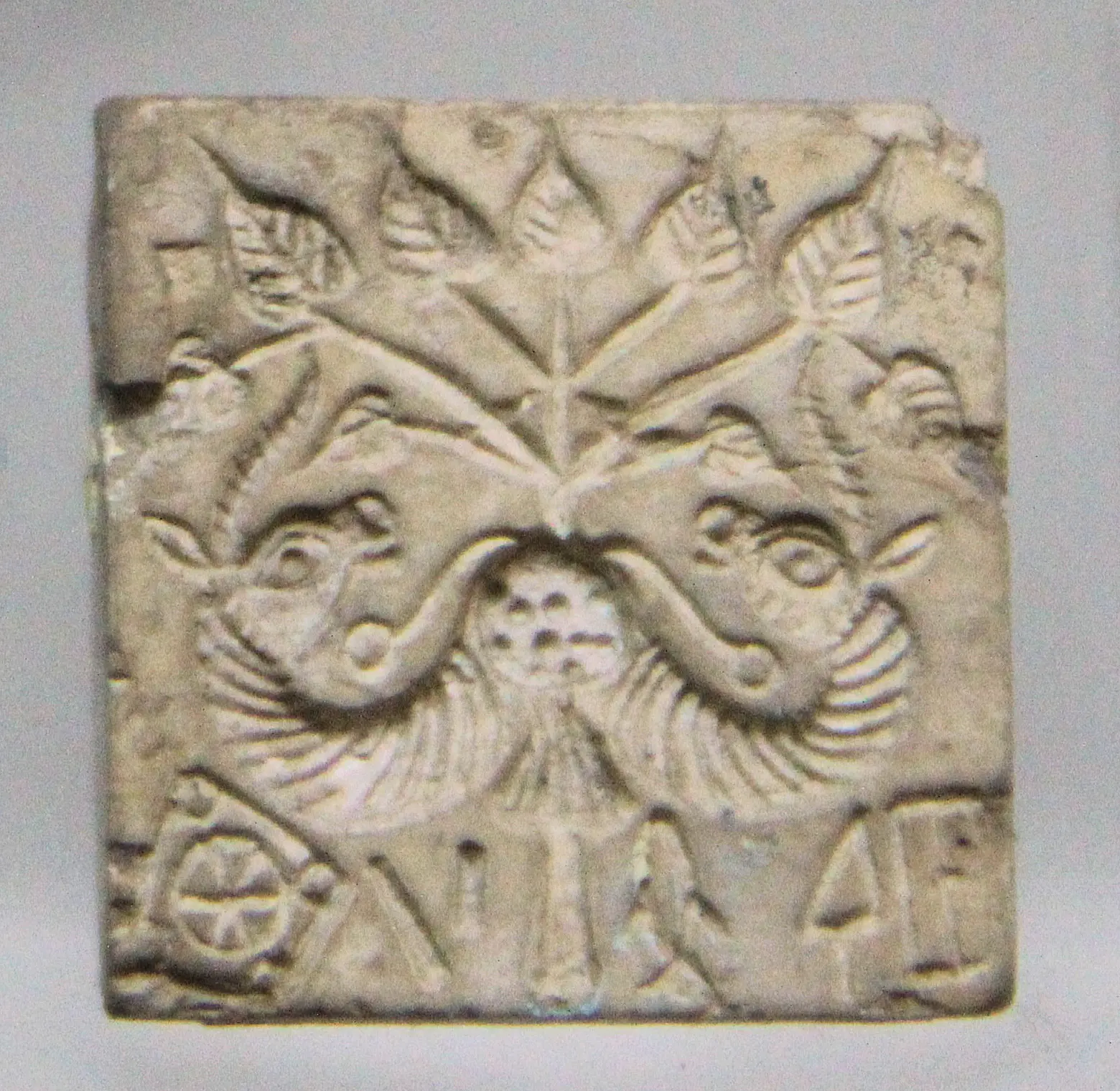
Harappan seals are among the most famous objects of the civilization. Many were carved from steatite, a soft stone that could be shaped and engraved before being hardened.
Typical seals contain two main elements:
- a short line of Indus signs, and
- an animal or other visual motif.
Animals represented include bulls, elephants, rhinoceroses, buffaloes and the famous so-called unicorn.
🦄 What Is the Harappan 'Unicorn'?
The most common animal motif on many seals is a creature shown in profile with what appears to be a single long horn. Archaeologists conventionally call it the unicorn.
This does not mean Harappans literally believed in the same unicorn known from later European mythology. The name is simply a modern label for the image.
The animal is often shown facing a stand-like object, sometimes described as an offering stand, brazier or ritual object. Its exact meaning remains uncertain.
🔐 What Were Seals Used For?
The exact function of every Harappan seal is not known, but several possibilities are strongly discussed.
Seals could be pressed into soft clay to create a seal impression. Such impressions may have helped identify goods, containers, individuals, institutions or transactions.
Some seals have a raised boss with a hole on the back, suggesting they could be carried on a cord.
Because the inscriptions cannot yet be read, we should say seals were probably connected with identity, administration, exchange or control of goods, rather than claiming one single proven purpose.
📦 Sealings and Trade
Clay seal impressions have been found in contexts connected with goods and packaging. At Lothal, seal impressions have been found with traces of materials such as woven cloth or packing surfaces.
This supports the idea that seals could be used in commercial or administrative activity.
They may have helped show who sent a package, who owned goods or whether something had been officially sealed.
🧱 Script Was Not Limited to Seals
Although seals are the most famous source, Indus signs also appear on:
- small tablets,
- pottery,
- copper and terracotta objects,
- amulets and bangles,
- tools and other artefacts.
This wider distribution tells us that writing or symbolic communication was used in several contexts, not only on seals.
🪧 Dholavira's Large Signboard
One of the most unusual examples of Indus writing comes from Dholavira, where archaeologists found a set of large signs associated with a gateway area.
These signs were much larger than the tiny inscriptions usually found on seals and are often described as a signboard.
This shows that Indus signs could also be displayed publicly, not only carried on small personal objects.
Unfortunately, because the script remains undeciphered, we do not know what the signboard said.
📜 Why Are There No Long Harappan Texts?
This is one of the biggest puzzles. Mesopotamia has thousands of long clay tablets, and Egypt has lengthy inscriptions. Harappan writing survives mainly in very short sequences.
There are several possible explanations. Harappans may have written longer texts on perishable materials such as wood, cloth, leaves or bark that did not survive archaeologically. Or the script may have been used mainly for short administrative or identifying messages.
At present, these remain possibilities rather than proven facts.
🧠 Can We Call It an Alphabet?
It is better not to call the Indus script an alphabet. We do not know whether individual signs represented sounds, syllables, whole words, numbers or combinations of these functions.
Some researchers describe it as logo-syllabic or propose other models, but no interpretation has yet achieved universal acceptance.
The safest term is simply Indus script or Indus writing system.
🔢 Were Some Signs Numbers?
Repeated simple strokes and other recurring signs may have had numerical functions in some contexts. Researchers study sign frequencies and repeated patterns to investigate this possibility.
But without decipherment, the value of individual signs cannot usually be stated with certainty.
🔍 What Can We Learn Even Without Reading It?
An undeciphered script is not useless. Archaeologists can still study:
- where inscriptions occur,
- which signs appear together,
- which signs appear most frequently,
- the direction of writing,
- the objects on which writing appears,
- regional differences in sign use.
This helps researchers understand how writing may have functioned socially and economically even before its language is known.
🧩 Why Decipherment Would Be Such a Big Breakthrough
If the Indus script were securely deciphered, historians might gain direct information about Harappan names, institutions, language, trade, religion or administration.
At present, almost everything we know about Harappan society comes primarily from archaeology. A readable written record could transform our understanding.
But a successful decipherment must explain large numbers of inscriptions consistently. Reading one or two symbols imaginatively is not enough.
⚠️ Common Exam Traps
- The Indus script remains undeciphered.
- Most inscriptions are very short.
- No accepted bilingual inscription has been found.
- The underlying Harappan language is still uncertain.
- Many inscriptions were probably written right to left.
- Seals commonly combine script with animal motifs.
- The so-called unicorn is one of the most frequent seal motifs.
- Dholavira is famous for a large arrangement of Indus signs often called a signboard.
- Do not call the script a proven alphabet.
🎯 10-Second Revision
Script: undeciphered + short inscriptions + no bilingual text.
Direction: commonly right to left.
Seals: steatite + script + animal motif.
Most famous motif: so-called unicorn.
Dholavira: large signboard.
📌 The Big Idea
Harappan seals and inscriptions show that the Indus Civilization had a sophisticated system of visual communication. The repeated signs follow patterns, and seals were probably connected with identity, administration or exchange.
Yet the most important fact remains simple: we still cannot securely read the Indus script. Until that changes, archaeology remains our main window into Harappan society.
Was this article helpful?
Help us improve by giving your feedback.
Test your understanding
What is the present status of the Indus script?
- A. It has been completely deciphered
- B. It remains undeciphered
- C. It is known to be Sanskrit
- D. It is identical to Brahmi
Despite many attempts, there is still no universally accepted decipherment of the Indus script.
Which material was commonly used to make Harappan seals?
- A. Iron
- B. Glass
- C. Steatite
- D. Marble
Many Harappan seals were made from steatite, a soft stone suitable for carving.
Which animal motif is especially common on Harappan seals?
- A. The so-called unicorn
- B. Kangaroo
- C. Polar bear
- D. Giraffe
The so-called unicorn is one of the most common and distinctive motifs on Harappan seals.
Why is the Indus script especially difficult to decipher?
- A. All inscriptions were destroyed
- B. It contains only one sign
- C. It was written only in modern times
- D. Texts are very short and no accepted bilingual inscription is known
The extreme brevity of the inscriptions and absence of a bilingual text are two of the biggest obstacles to decipherment.
In which direction are many Indus inscriptions generally believed to have been written?
- A. Bottom to top only
- B. Right to left
- C. Always left to right
- D. Only vertically
Many Indus inscriptions are generally interpreted as being written from right to left.
Why is Dholavira important for the study of Indus writing?
- A. It contains the Rosetta Stone
- B. It has a fully translated royal archive
- C. It yielded unusually large Indus signs associated with a gateway area
- D. It contains the first Brahmi inscription
Dholavira is famous for large Indus signs associated with a gateway, often described as a signboard.
Which statement about Harappan seals is the most historically careful?
- A. They were probably connected with identity, administration or exchange, but their exact meanings are uncertain
- B. Every seal is known to contain the name of a king
- C. They were used only as jewellery and had no communicative function
- D. Their inscriptions have all been translated
Sealings, bosses and archaeological contexts support administrative or exchange functions, but undeciphered inscriptions prevent certainty about each seal's exact meaning.
Why should the Indus script not simply be called an alphabet?
- A. Because the Harappans had no writing
- B. Because alphabets can only be written on paper
- C. Because it contains only numbers
- D. Because we do not yet know whether its signs represented sounds, syllables, words or combinations of these
The linguistic values and structure of the signs remain uncertain, so 'Indus script' is safer than assuming an alphabetic system.